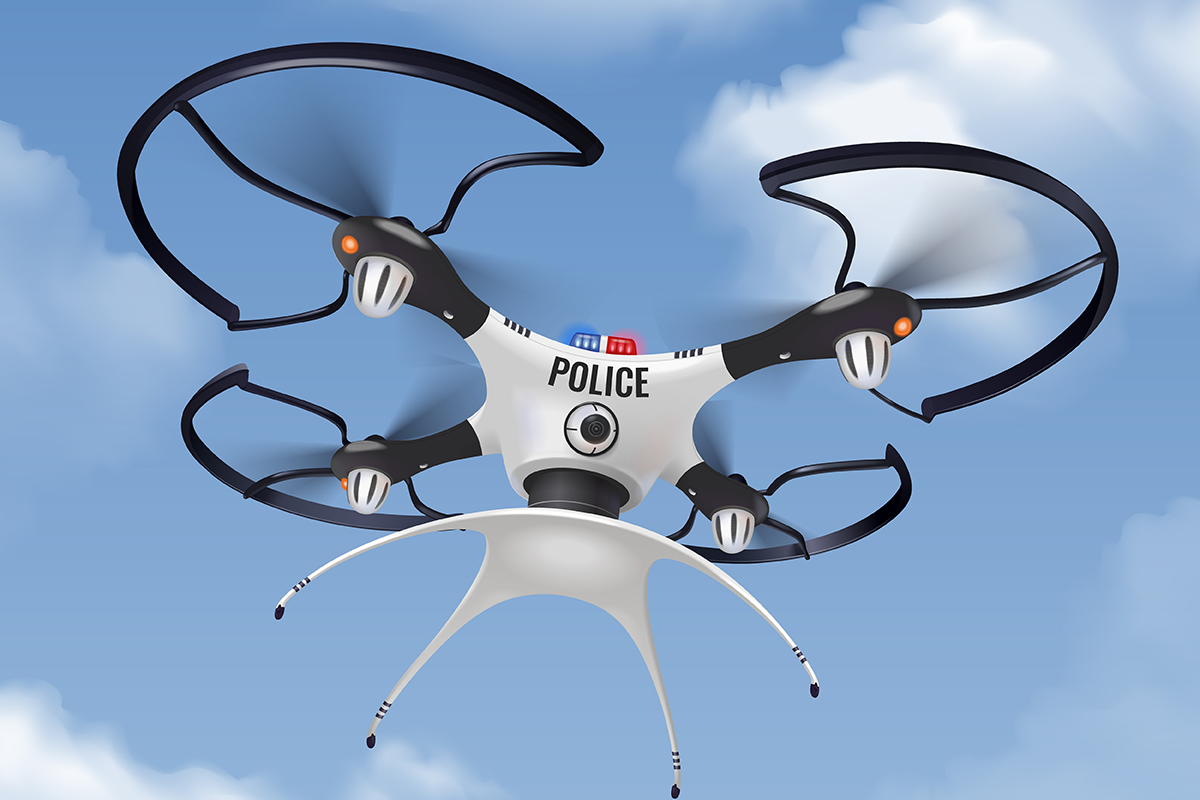
In November, a suspected car thief shot a 9mm pistol twice at a pursuing police drone in Lee’s Summit before officers caught him in a backyard. Occurrences like these are becoming more commonplace.
In both Kansas and Missouri, police departments are using drones, or unmanned aerial vehicles (UAVs), as first responders to crimes or just to keep a watchful eye on a large gathering. In the case of Lee’s Summit, site of the failed car heist, the police department has used drones since 2018.
In mid-November, KCMO’s city council approved $500,000 to go toward its drones-as-first-responders program that debuted in the fall. “This is easier than I thought it would be,” said Councilman Wes Rogers, co-sponsor of the drone-funding ordinance, after realizing that there was no opposition present at the meeting before a unanimous vote in favor.
And he’s right. It’s a little weird.
You’d be pressed to find any widespread opposition in the area to camera-equipped drones. In the case of the Kansas City Police Department, its DJI Matrice 4TD machines each have three cameras equipped with wide-angle and super-telephoto lenses. The drones also have night vision and an infrared thermal camera that can track a hidden subject by the heat emitted from their bodies.
Maybe people just don’t think it’s a big deal. Maybe they’re not worried about police or other government agencies spying on them—a concern that wouldn’t seem absurd considering today’s digital landscape. Or maybe those fears are outweighed by the hope that drones might just be a viable crime-fighting tool that could curb gun violence. After all, KCMO’s homicide rate is at record high.
Maybe since inexpensive high-resolution security cameras are ubiquitous, the presence of more lenses overhead doesn’t lead to fears we’re headed toward a 1984-ish reality—we might already be there.
And though we’re bound to hear more stories about trigger-happy folks trying to shoot down UAVs, there might also be reports, like the one out of Phoenix, Arizona, in December, where a first-responder drone found a stranded hiker in the Camelback Mountain area.
Amazon’s Prime Eyes
Another institution watching you from above is retailer Amazon with its Prime Air drones. Amazon was given the go-ahead to deliver residential packages around parts of the metro. The 83-pound Prime drones are four feet 11 inches tall, five feet six inches wide and drop parcels 12 feet from the air onto a customer’s property.
Residents of both KCMO and KCK (non-Prime members, one would assume) had opportunities earlier to voice their concerns at Amazon-hosted events, where company representatives painstakingly answered questions from the media and public. Any concerns about safety, noise or appearance were outweighed by the attraction of getting an item delivered to your doorstep in under an hour. Other retailers are sure to follow; Walmart, for one, started drone delivery in Atlanta in early December.