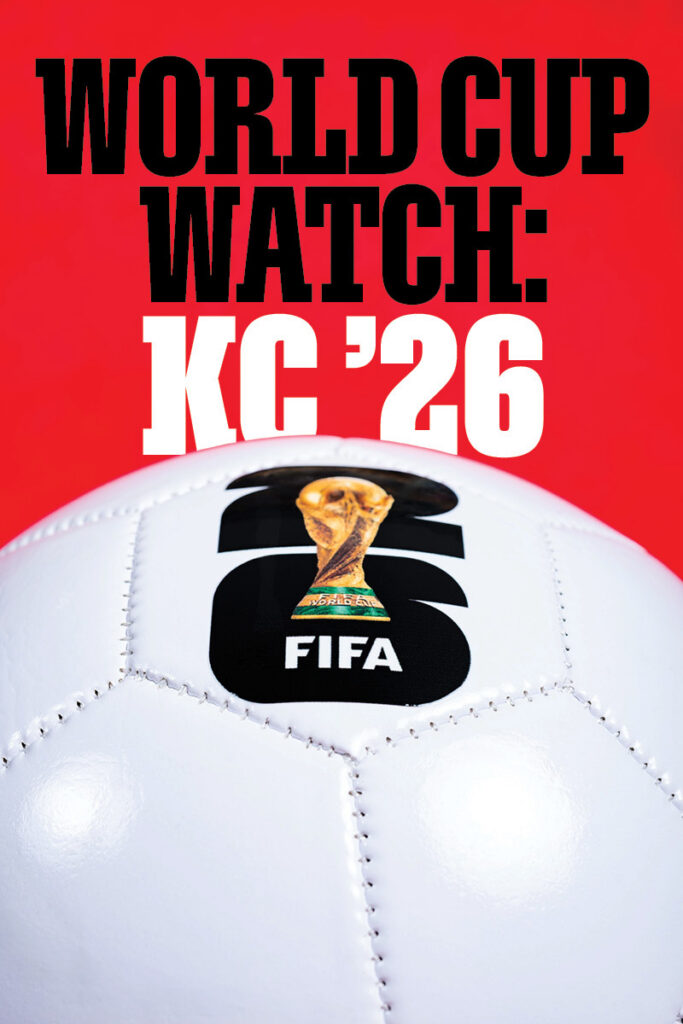
Kansas City is about to step onto the world’s biggest stage. This summer, the FIFA World Cup arrives in our backyard, bringing with it an electric mix of global culture, competition, and once-in-a-generation energy. For a city that already knows how to host—whether it’s championships, festivals, or packed parade routes—this moment is both a challenge and a celebration. And it’s already transforming the region in ways big and small.
Every Wednesday in the weeks leading up to kickoff, Kansas City magazine will be diving into everything that makes this World Cup moment uniquely Kansas City. We’ll explore how local businesses are gearing up for an international influx, spotlight the athletes and fans who are shaping the soccer scene here at home, and take you behind the scenes with the organizers, creatives, and civic leaders working to make sure the city is ready for its global close-up.
KC’s Soccer Heritage
Although the city has had a bumpy like-love affair with soccer over the last 50 years, it has never lost its desire for the sport.
Back in the late 60s, when soccer first came to town, it was not the favored go-to sports entertainment in this football-heavy city. Not by a long shot-on-goal.
The city’s first outdoor soccer team, the North American Soccer League’s (NASL) Kansas City Spurs, brought to the city in 1968 through negotiations with Lamar Hunt’s United Soccer Association, limped out of town in 1970 after two years playing in Municipal Stadium. It was unpopular with fans even after an out-of-character 1969 NASL championship win.
Soccer, it seemed, was a no-go in KCMO.
Then lightning in a bottle hit in 1981 when the Kansas City Comets, a Major Indoor Soccer League (MISL) team, rolled out their first home game in Kemper Arena.
It opened like a rock show, blasting out a theme song with a barrage of sweeping laser lights that followed the players as they were introduced by a booming voice. That’s how every home game began. Energetic crowds of 16,000-plus packed Kemper Arena, and the team was cheered on by a new generation of soccer moms, dads and their soccer-team kids. This new legion of Comets’ fans began creating their own suburban soccer leagues.
The Comets had their own local beloved hero—Gino Schiraldi, who averaged four goals a game. The Comets’ stats proved they were winners, placing 2nd in the MISL three times and making the playoffs seven out of their 10 years here.
Although fickle fans started staying home, and, in 1991 attendance dropped to 7,000. The Comets shut down. But that failure did not upend KC’s growing soccer presence.
A few years later, soccer found its footing again with the Kansas City Wizards men’s outdoor Major League Soccer (MLS) team in 1997. The Wizards, founded and owned by Lamar Hunt, played first at Arrowhead. Hunt eventually sold the team and it transitioned to what we now know as Sporting KC in 2010 playing at the 18,000-seat Children’s Mercy Park in the Legends shopping district (which changed its name to Sporting Park in 2026). Patrick Mahomes became a co-owner in 2021. Peter Mallouk, CEO of Creative Planning has a majority interest.
The team won the MLS Cup in 2000 and 2013, and the U.S. Open Cup in 2004, 2012, 2015 and 2017.
Then there’s the wildly successful Kansas City Current outdoor National Women’s Soccer League (NWSL) team, founded in 2021 and co-owned by both Patrick and Brittany Mahomes, playing in the CPKC Stadium at the Berkley Riverfront, the first stadium in the world built for a women’s professional sports team.
In the 2025 season, the team set new NWSL records for wins (21), points (65) and shutouts (16) while earning a league-record 11 home victories. They became the first team in NWSL history to sell out every regular season match in 2024, and again in 2025.
Finally, there is a second iteration of the Kansas City Comets, re-introduced in 2010 after their ten-year run in the 1980s, playing ever since at Cable Dahmer stadium.
All this activity has demonstrated an active local soccer fan base that has helped queue up interest from Fédération Internationale de Football Association (FIFA) who selected Kansas City as the host city for six 2026 World Cup championship games this summer.
With professional soccer in KC over the years, fewer mistakes were made and more problems were solved. And maybe that’s as it should be. There’s a saying attributed to Dutch soccer player Johan Cruyff: “Soccer is a game of mistakes. Whoever makes the fewest mistakes wins.”