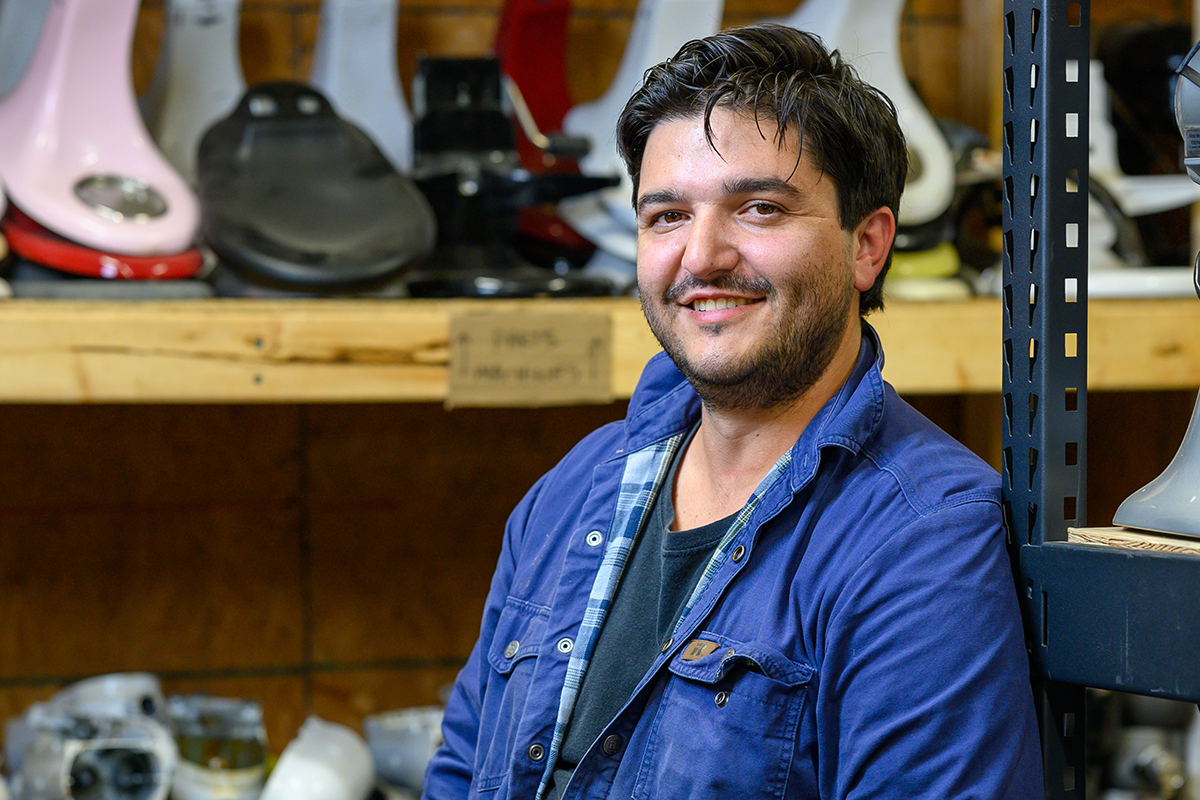
Suppose you are April Watson, senior curator of photographs at the Nelson-Atkins. You can curate a show called “American Prospects and Landscape Photography, 1839 to Today,” but someone has to get the images out of storage and onto the walls of the Bloch Building. For that, you need a phenomenally talented human like Saori Lewis, a conservator of photographs at the Nelson-Atkins.
Kansas City magazine met Lewis in the museum’s behind-the-scenes restoration lab, where she explained the painstaking process of getting rare photographs ready to view.

She starts months before an exhibition opens with a list of every image in the show, diving into the Nelson’s massive database to study each item’s exhibition history. The photographs are terribly fragile, so her first step is light measurements and estimates.
“I do some calculations to quantify how much light a photograph has had,” Lewis says. “Then I calculate how much we anticipate for the next display.”
That is, she measures the intensity of the light, multiplying that by the number of hours the lights will be on in the galleries over the exhibit’s run.
Next, she takes extensive notes on each image, including the photographic process itself, how the image was mounted and originally presented by the artist and condition issues, like soiling or tiny rips.
After that, Lewis decides how to prepare each picture for public display. Her priority is anything that might interfere with the viewing of the photographs or impact the image’s long-term stability.
“Dirt can interfere with the overall appearance,” she says. “It’s usually so thin that you can’t see, but dirt is bad for image preservation because it attracts moisture. And it can transfer onto other things and hold acidity, which degrades paper.”

From there, she writes formal proposals for any image that needs treatment. Those treatments range from simple to crazy complex.
After taking an image of the photograph she plans to treat, documenting its condition, she might simply clean the surface using soft brushes. After that, she could humidify the image and bathe it in a tray of water. There might be a “bleaching step” —gently using light or chemical agents to reduce discoloration.
She also does a lot of flattening.
“Undulation is a common problem,” she says. “Like a wobbly picture. So when it’s on the wall, it doesn’t look good. It casts these, like, wavy shadows. So pressing and flattening is a step that I do a lot.”
As you might suspect, this work takes tons of education. Originally from Japan, Lewis got her bachelor’s degree in studio art from the Kansas City Art Institute, then a master’s in art conservation from Buffalo State.
A steady hand matters too, particularly in the “consolidation of emulsion.”
“For a standard black and white picture — a silver gelatin print — the image is held on a really thin layer of gelatin, like hardened gelatin,” Lewis says. “It’s kind of hard and it snaps easily.”
She repairs those flaws by introducing a tiny amount of warm, extremely pure gelatin to the surface with a fine-point brush—while looking through the massive microscope she calls her “best friend.”
After more documentation, she finally passes the image on to a matting and framing specialist. Then it goes to the installer who hangs the pictures.
Once the images are on the wall, Lewis has one last task: more measurements of each work’s light exposure and color condition. That gives her “a reference point to make recommendations for the future.”
The future. That’s what Lewis’s work is all about. The record-keeping and caretaking is done to ensure that these images can be seen and enjoyed by generations to come.
“For hundreds of years, I hope,” she says.
GO: “American Prospects and Landscape Photography, 1839 to Today.” February 7–August 2, 2026. The Nelson-Atkins Museum of Art.