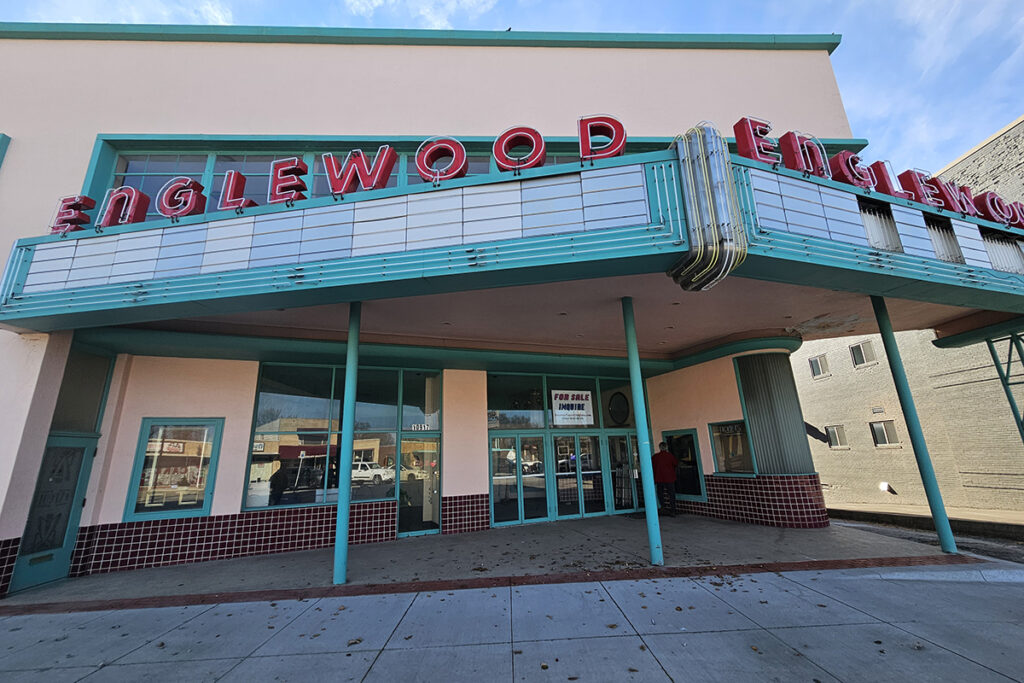
It’s just a matter of time before the Englewood Theater marquee lights up again.
For decades, the Independence institution has lived in the collective memory of residents. “When you talk to people, it’s still so fresh in their memory,” Brent Schondelmeyer says. “‘I saw Kris Kristofferson there,’ ‘I saw Ben-Hur with my father,’ ‘I had my first kiss there.’” After years of false starts, the empty historic venue is finally on the road to redemption.

Schondelmeyer is the president of Friends of the Englewood, a nonprofit dedicated to restoring the long-dormant theater. “I heard people complaining about the theater,” he says, “and I asked myself: Could I focus my time and effort and energy in not complaining about the Englewood Theater, but instead giving it a different future?”
The Englewood opened in 1949 when Winner Road and the surrounding area were newly incorporated into Independence. Over the years, it served as a movie theater and, later, from 1978 on, as a live performance venue under the name KC Opry. By the early 2000s, the theater’s usage steeply declined, and it shut its doors in 2007. Since then, the building and its adjacent commercial block, including a former Ben Franklin store, have sat mostly vacant.
Friends of the Englewood, a nonprofit that partnered with Truman Heartland Community Foundation as its fiscal agent, signed a contract in early 2024 to purchase the theater. The group officially closed on the $600,000 deal in November 2025, marking a major milestone for the neighborhood. The acquisition, financed through a promissory note from private individuals, is only the beginning, Schondelmeyer says. The group also has their eyes on the empty Ben Franklin store.
The theater has also been approved for listing on the National Register of Historic Places—a designation that will make it the youngest historic property listed in Independence and unlock crucial preservation tax credits. “Preservation tax credits are very, very potent because they are cash,” Schondelmeyer says. “This money is hard to raise.”
Draw Architecture, a local firm that specializes in adaptive reuse and historic projects, is leading the design work. Managing Principal Dominique Davison says the building’s mid-century touches are going to be kept intact as much as possible. “The late 1940s, early 50s kind of architectural style is just really fabulous,” she says. “The marketing, the signage, the lighting, the ticket booth, the little details—I love these kinds of spaces for performance and gathering and the arts because they’re critical to providing opportunities for artists and youth and the community to come together.”

Rather than restoring the theater identically back to its original glory, the team is reimagining it for contemporary use. The venue originally sat more than 1,000 people, but the new design will more comfortably house 300 to 400 seats. The hope is to make it a multi-use space capable of hosting events like community plays, high school chamber groups, ballet performances, rock concerts and film screenings.
To function as a modern performance venue, the building will need some technical upgrades. Davison says the team will need to conduct sight line studies, raise and resize the stage, and make acoustic adjustments to accommodate different types of performances.
Schondelmeyer sees the theater as something larger than a single venue. “I see this as having the opportunity of being a cultural hub for eastern Jackson County,” he says. “There is an aspect about Englewood that feels a little distinctive, like a little small town.”
Davison’s team conducted their first comprehensive assessment of the building in November, and the path forward remains contingent on funding and detailed structural evaluation. “It’s a community event, and the theater is now under community ownership,” Schondelmeyer says.