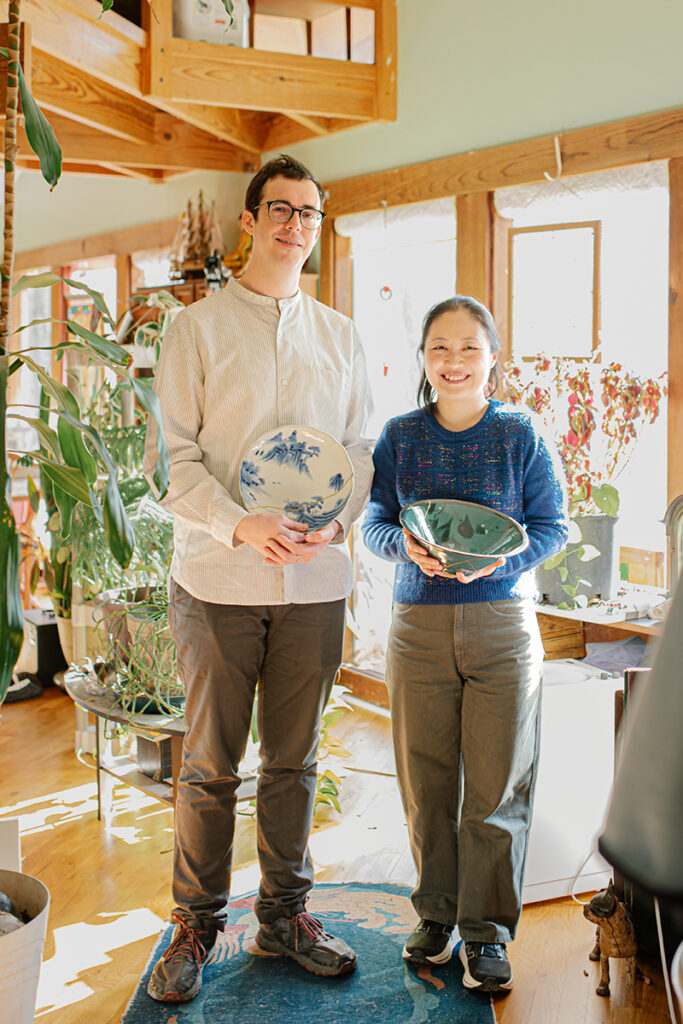
In a world where “new” often means “better,” Joseph and Maiko Anderson-Story of JMCraftstore are building a business around the broken.
From their studio in Baldwin City, the couple practices kintsugi—the ancient Japanese art of repairing ceramics with lacquer and precious metals. Instead of hiding flaws, kintsugi highlights them, transforming heirlooms into objects more beautiful for having been broken.
Kintsugi, which dates back to the late 1400s, began when Japanese craftsmen started using urushi, a natural tree sap lacquer, to fuse ceramics back together and finish the seams with gold or silver. The method became closely tied to the tea ceremony and philosophy of wabi-sabi, which embraces imperfection and the passage of time. More than a technique, kintsugi treats breakage as part of an object’s story.
That philosophy is near and dear to the Anderson-Storys. Their journey began in Seattle, where a coworker introduced Maiko to the craft. “There are so many broken ceramics out there,” she says. “Fortunately, local ceramic artists provided us with practice pieces.” The two are a perfect team: Joseph is trained in ceramics and glass, and Maiko—who studied printmaking and art therapy—brings an eye for the detail and emotional sensitivity that this restoration requires.
What started as a side project grew quickly during the pandemic. As people spent more time at home reassessing what mattered, repair requests increased. “People wanted to improve life in their homes, so that’s how our business grew,” Maiko says. Eventually the two relocated to Baldwin City to care for family, but most of their commissions still come from the West Coast.
The process of kintsugi is very slow and intentional. Using urushi lacquer (the aforementioned tree sap, which comes from the same family as poison ivy), they create a paste of lacquer, flour and water. Each layer must cure at specific temperature and humidity level, and most projects take around three months, depending on size and complexity. The occasional glass repair work takes even longer.
The pair remains committed to traditional methods, even as modern kintsugi has grown in popularity. “A lot of people can do a version of it in an afternoon using a two-part epoxy,” Joseph says. Their reasoning for staying old school is not just for integrity but also practicality. “A big part of why we stick with our traditional repairs is it’s also food-safe,” Maiko says. Restored cups, bowls and plates can go right back to everyday use.
Another key element of Joseph and Maiko’s philosophy: They will not permanently break something for the sake of kintsugi. Instead, clients commission JMCraftstore to repair pieces, or they’ll find and salvage already-broken pieces that they feel could use a second life.
As interest in the art of kintsugi grows, the two have considered hosting workshops to teach the craft, though condensing a months-long process into a few hours remains a challenge. For now, they continue their steady work from Baldwin City, mending fractures one piece (and one dollop of urushi) at a time.
Learn more at jmcraftstore.com.