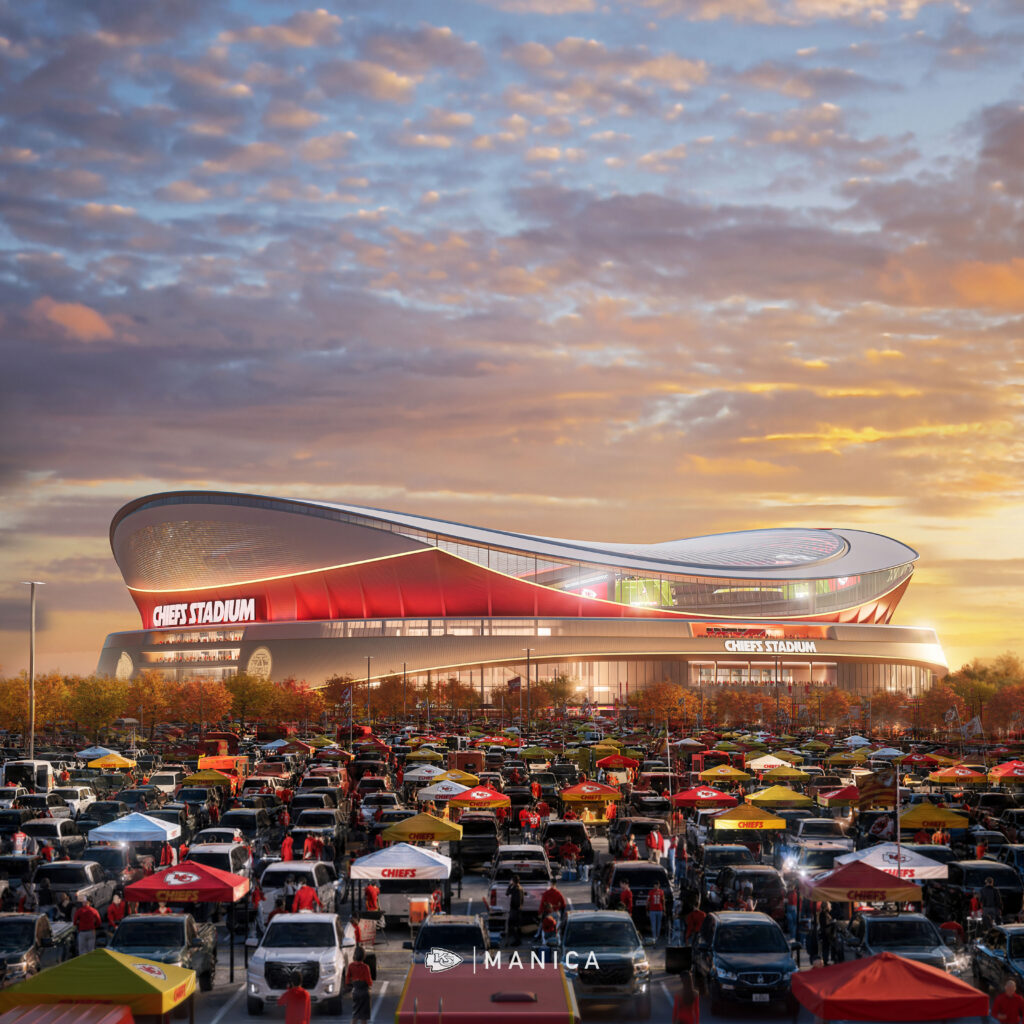
It’s a stunner. A spectacular show-stopper. A sports stadium fit for a king-dom.
Preliminary renderings of the new $3 billion Chiefs stadium expected to open no later than August 2031—just in time for the 2031-2032 season—were recently revealed.
After everyone was able to stop being awe-struck and finally focus on what they were seeing, the descriptions started flowing: looks like a graceful spaceship – less of a traditional football stadium and more like a modern entertainment pavilion – a true gift to the city that makes Kansas City proud.
Yes. Yes. And most indubitably yes.
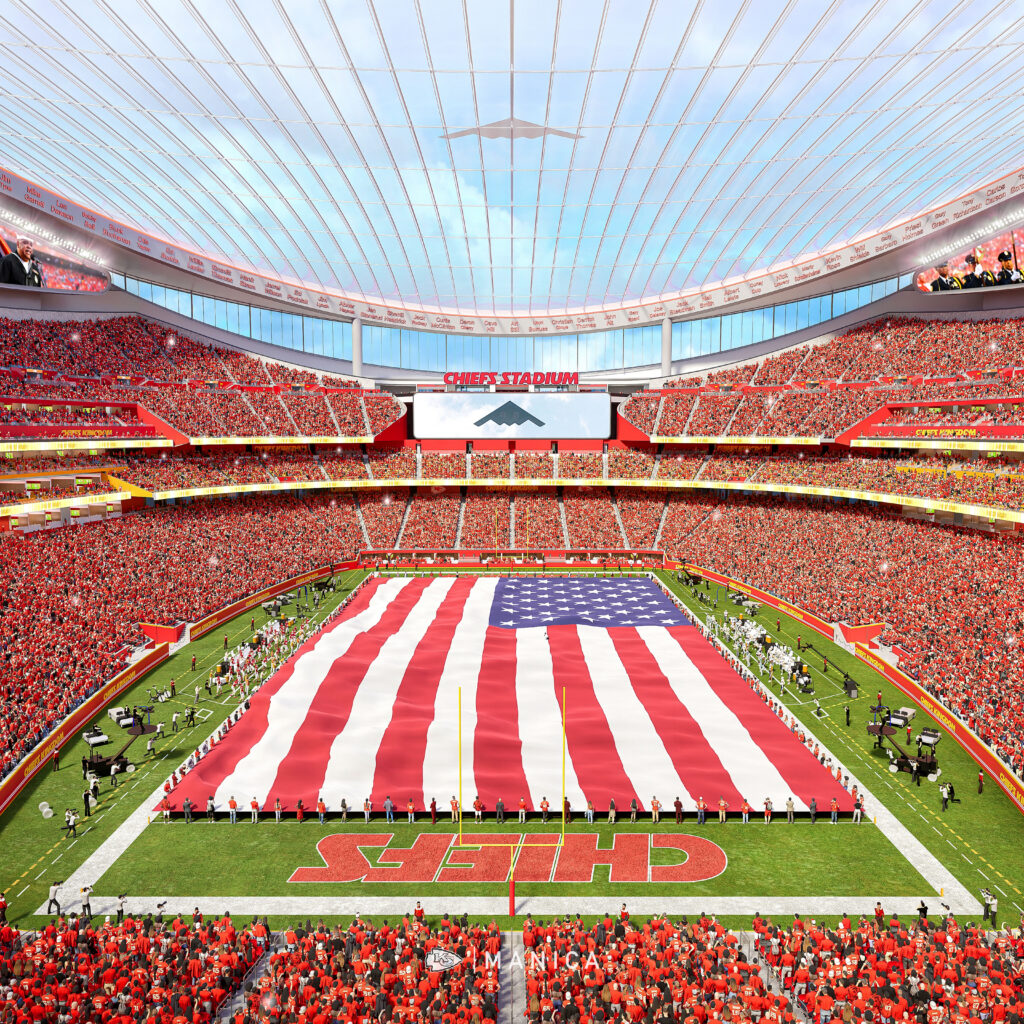
The yet-to-be-officially-named stadium features a completely enclosed roof of 400,000 square-feet of translucent ETFE panels (ethylene tetrafluoroethylene), a lightweight plastic alternative to glass. The proposed stadium has a total fan capacity of approximately 70,000, and more than 20,000 parking spots. A statue of Lamar Hunt will be in a plaza space outside, near an expanded Chiefs Hall of Honor and Chiefs team store.
The stadium also functions as the anchor tenant for a $1 billion mixed-use development to be completed by the end of 2038, according to the sales tax and revenue bond agreement.
The exact footprint of the stadium and mixed use development will be somewhere in KCK near the Kansas Speedway, between Parallel Parkway and State Avenue, and 126th and 118th streets. (“When we hear, you’ll hear,” KCK mayor Christal Watson told KCTV-5 on July 22).
In addition, a new $300 million Chiefs headquarters and practice facility will be built by local engineering and construction company Burns and McDonnell on approximately 155 acres near the intersection of College Boulevard and Ridgeview Road in Olathe. It’s set to open before the beginning of the 2031 season.
Home-town architect David Manica is the stadium visionary who transformed an ambitious concept into stadium reality. “It was a little bit more daunting and higher pressure to do something at home for our own team,” he told KCM. “I’m happy to say that the inspiration flowed from the existing Arrowhead and the legacy of that. Listening to what the project wanted to be as an evolution of a building that the city already loved was where we started, and where we ended.”
Manica says that the design team was really careful about measuring and managing the density and the loudness of the building. “All of that sound energy is captured and contained within the building in a way that even existing Arrowhead cannot do,” he says. “Our acoustic engineers analyzed our new design and proved that it’s actually going to be louder.”
Everybody is getting a seat upgrade, he says. “There’s more people sitting in the lower bowl than there are in the existing Arrowhead. Every person’s going to have more legroom. Every person’s going to have more seat width.”
The design’s attention to tailgating is pretty cool. “We never thought of this project as a stadium in a parking lot,” Manica says. “We thought of this as a stadium within a tailgating experience. In every way, tailgating drove the way the entire site and master plan were laid out.”
The building has integrated green spaces that allow people to flow out of their parking stalls into more of a “procession of fans,” he says. “That is going to be a new fun tradition as people march towards the stadium for the game after they’ve finished tailgating.”
Manica says that, in a lot of ways, the stadiums are the modern cathedrals that a city can build. “They are some of the most recognizable buildings in any city. When you see a stadium and you recognize it, you know where it is. It’s a signature for the city.”
Tom O’Grady, president of HNTB, the stadium project’s architect of record, told KCM there’s an opportunity with the new stadium to host future events like the Super Bowl, the NCAA basketball tournament, and other events throughout the year. “It just really elevates what Kansas City will be able to do, what Kansas City will be able to host, and just continue to elevate what is already an extremely well-respected and appreciated sports town and take it to new levels,” O’Grady says.
Manica says that he wants Chiefs fans to feel at home, and feel excited and proud when they first walk into the new stadium. “I want them to feel, in some ways, a sense of relief that we got it right and we exceeded their expectations, and that this is the building they want to go to see Chiefs games for the rest of their lives,” Manica says.