Just as you’re thinking about that great sweet dessert you had last night, a quick look at your calendar sends a cold shiver down your spine: It’s time for your twice-annual visit to the dentist.
Gulp. That sudden chill you feel is a real anxiety disorder called dentophobia.
Time to steel yourself up for laying down on a treatment chair and surrendering your mouth to an up-close-and-personal intervention most of us would rather avoid.
But stand by, ye seekers of the perfect smile. High-tech solutions are here to rescue us from this necessary inconvenience.
According to the American Dental Association, more than 72% of dental patients are fearful about heading to the dentist. One-third call it an extreme fear. The anesthetic needles, the whirring drills, the gagging reflex from suction, a hygienist leaning in too close for comfort—all play into that uncomfortable intrusive feeling. In fact, just the sound of the drill causes the most fear, according to the report.
In hopes of alleviating much of that fear, dentists and their patients are embracing new technology and eagerly awaiting more advances.
FDA-cleared AI tools are changing the way dentists use X-rays and other dental images. These technologies can help dentists spot potential problems, plan treatments and track a patient’s progress over time. One of those AI tools, the VideaHealth AI platform, is being used by Heartland Dental, one of the country’s largest dental support organizations working with a group of Kansas City dental offices. More information processed and stored in a patient’s digital profile means more convenience for both patient and dentist.
Dr. Melanie Beck, the director of digital dentistry at the UMKC School of Dentistry, ran her own business, Capstone Dentistry, in Shawnee until July 2023. In April, UMKC hired her to build and manage a dental digital curriculum. “The goal is to try to change the curriculum and make it more digital,” she says. “That means integrating all kinds of things, like computer-aided design, computer-aided manufacturing, scanning, milling and 3D printing.”
In her practice, she did 90% of the crowns. The scan process involves using a small handheld wand connected to a computer to capture a rapid 3D digital model of a tooth. Scans are then sent directly to software to design crowns, veneers and other restorations. “Once you go to scanning, you’ll never go back to conventional impressions, which are usually made using sometimes messy physical putty,” Beck says. “There’s nothing you can do with an impression that you can’t do better with a scanner. It’s more comfortable for the patient.”
Larry Sturm, the president of lab services for Dental Art and Design, agrees. “Say you have a digital denture made from a 3D digital scan,” he says. “You can go into an office and have that denture reprinted the same day, which is kind of nice because that eliminates the back and forth visits to the office.”
Today’s dentist can also use 3D printing to make precise dental restorations.
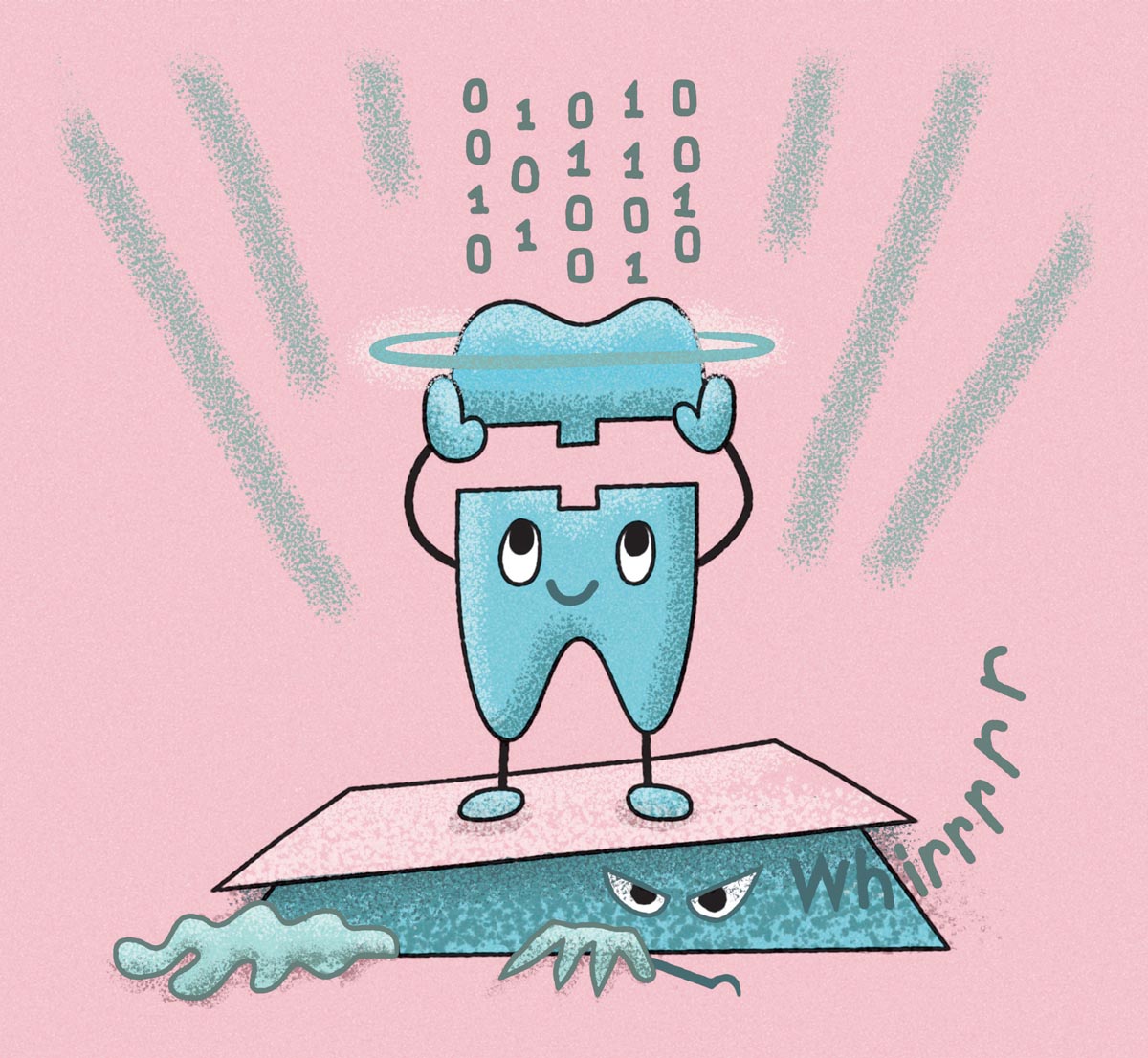
Crowns are usually carved out of a block of porcelain or a similar material with an expensive milling machine available in most labs and some dental offices. Now, a 3D printer using a digital scanned-in intraoral image can print out a crown made of porcelain particles in a resin mix. While that composite crown is not as strong as a milled porcelain crown, it’s an option for expediting a replacement.
One of the things most patients dislike is getting the temporary crown that has to be worn for a couple of weeks while the lab makes their definitive milled crown. “Then let’s say that it doesn’t fit,” Beck says. “Now they’ve got to send it back to the lab.”
With a digital scanner and an in-house computer-aided design system, the process can be completed in 90 minutes. “There’s a lot of headaches for the patient that are just completely eliminated,” she says.
The bad thing about digital is that there is a lot of calibration to be done, Sturm says. “The scanner has to be calibrated; the printers have to be calibrated regularly,” he says. “That’s something you have to really keep up on. The big negative for me on digital is the drawback because it’s cloud-based. If the internet’s down, you’re down, and that’s kind of tough.”
Beck says that there are still some things that need to be worked out. “When I really think about 3D printing and the future of dentistry, it boils down to this: Dentists have to be artists, and we have to be able to shape things with our hands into something beautiful. 3D printing will level the playing field, so every dentist will be able to utilize a computer to make something as beautiful as possible, and then the 3D printer will be able to print it for them. That’s really exciting.”