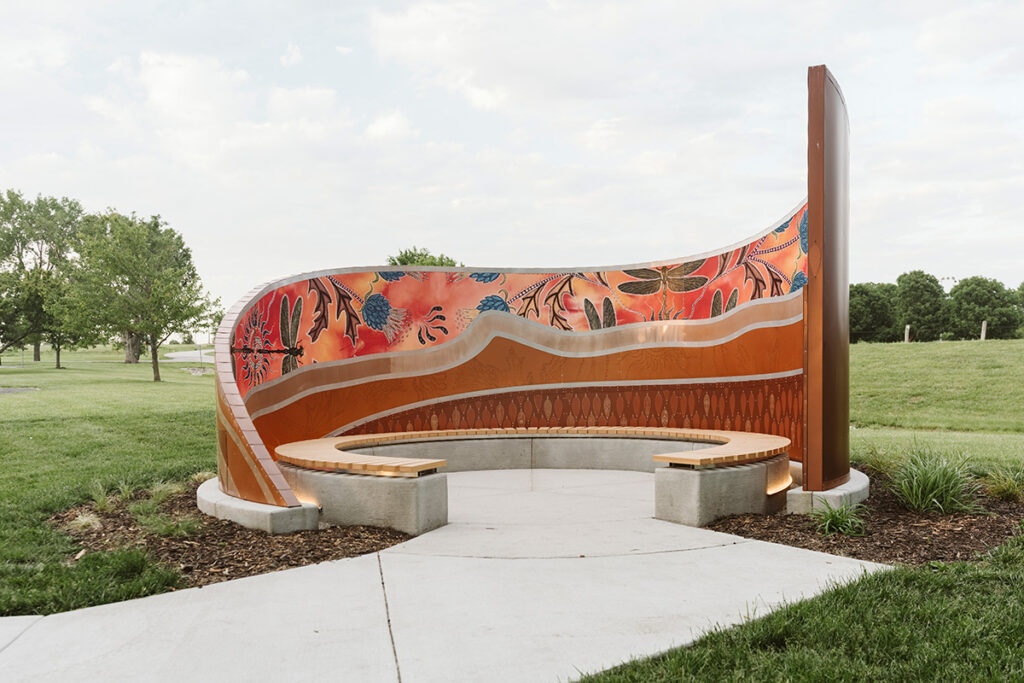
Today, Heritage Park in Olathe has a number of reasons to visit: softball fields, fresh walking trails, a marina. But a piece of the park’s history is giving people another reason to visit and reflect.
In 1838, 859 members of the Potawatomi Nation were forcibly removed from their homes and marched westward in what became known as the Trail of Death, a route believed to have passed through the very land that Heritage Park sits on. Since the 1980s, a rock and plaque near the park’s marina has marked that history, but the remembrance recently transformed into something bigger.
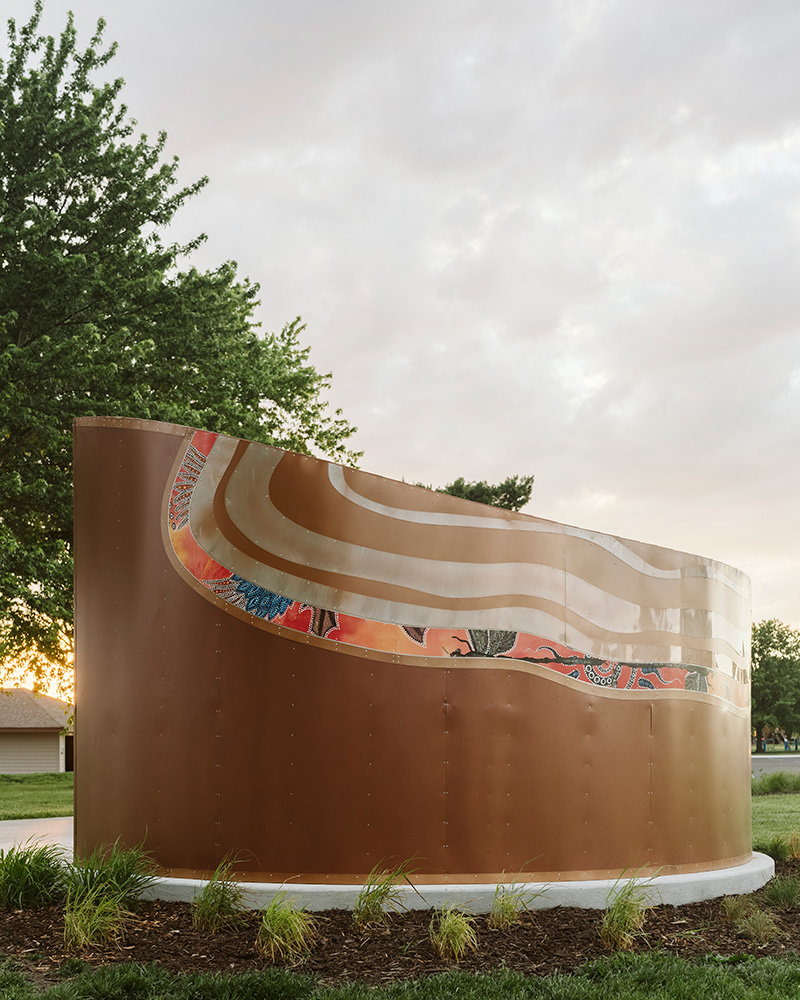
Fire Keepers Circle, unveiled last summer, is a circular art installation that stands in Heritage Park now, and it’s believed to be the only commemorative installation ever created for the Potawatomi Nation in honor of that forced march.
“What I love is that it all started with relationship building,” says Susan Mong, superintendent of culture for the Johnson County Park and Recreation District. “When I think about this whole project, that piece of art is stunning—during the day, during the night. But what really wells up for me is the relationships, the trust that was built and the fact that we did it the right way.”
Doing it the right way meant starting even before a concept was designed. In 2023, JCPRD invited Citizen Potawotami Nation members, who make a pilgrimage along the Trail of Death every five years, to share breakfast and conversation. “To meet the ancestors of folks that survived that,” Mong says, “that’s something you just can’t really put words to.”
From there, the art selection committee was built to include tribal members, applications were limited to Native American artists, and community engagement extended all the way to the tribe’s national family reunion in Shawnee, Oklahoma, which Mong attended.
“To be invited into that sacred moment for the Potawatomi people was probably one of the most rewarding things I’ve ever experienced,” she says.
The winning piece was curated by artists Leah Yellowbird and Aaron Squadroni. Its circular form reflects the fire keeper tradition, which is a sacred symbol of family and tribe gathering, and the curved panels mirror the path of the Trail of Death itself. Eight hundred and fifty-nine small holes are pierced throughout the sculpture, one for each individual who made that march, symbolizing light after dark.
Tribal members from across the country also mailed in hand-drawn family designs pulled from belts, moccasins and other heirlooms, which were fabricated onto feathers on the art piece. “One of the things that’s been so cool is to see people come and look for their feathers and go, ‘There it is. We’re a part of this piece,'” Mong says.
Leah Yellowbird passed away just months before the installation was complete, but her mark is left with the care she poured into every part of the work.
Heritage Park sees nearly 900,000 visitors annually, according to Mong. “Even if you don’t know any of the details, you know that it’s a place where everybody is invited in to just sit and be.”
Fire Keepers Circle is located at Heritage Park, 16050 Pflumm Road, Olathe.