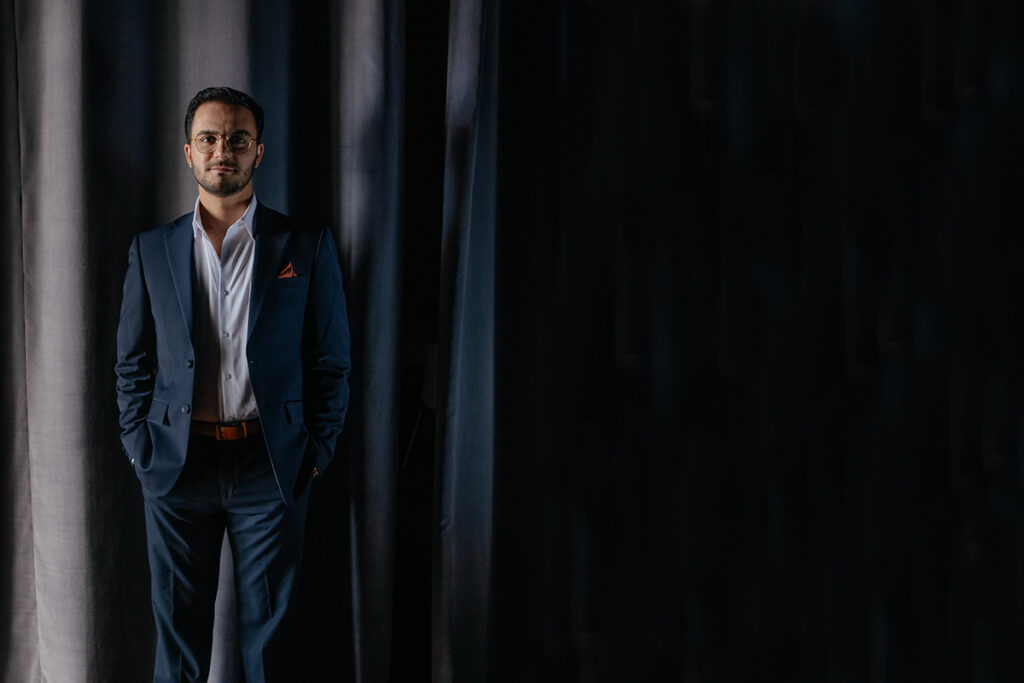
Trumpet player Ahmad “Baset” Azizi is used to being in the media spotlight. It started 10 years ago when, as a young Afghan refugee, Azizi made it to America on his musical talent. But it’s his determination to leave the world a better place than he found it that has kept him there.
Most recently, the Johnson County, Kansas, resident received national attention for playing “Taps” in remembrance of Army Specialist Sarah Beckstrom, a national guardswoman who was murdered last Thanksgiving in Washington, D.C. An Afghan national has been arrested for her murder.
Azizi, who now helps relocated foreign refugees and immigrants adjust to life in the United States, hadn’t picked up a trumpet for three years when Beckstrom was shot. He reached out to her family and practiced constantly for two weeks until her memorial service. In the end, her family decided on a private funeral, so Azizi took his performance to social media with the help of a professional videographer in a Lawrence performance space. It went viral.
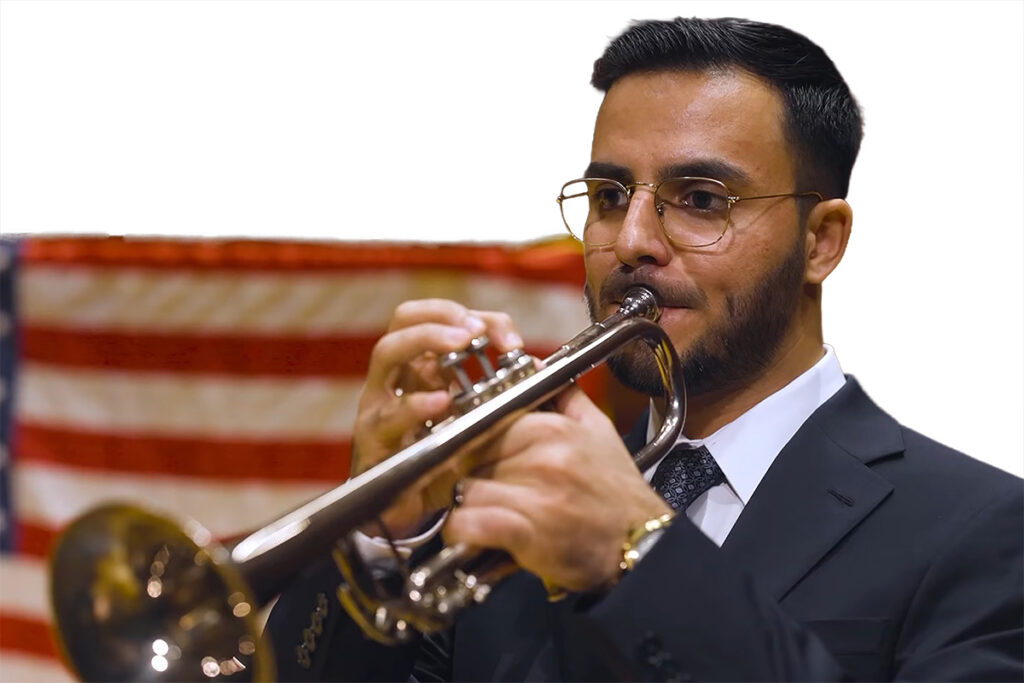
“I felt compelled to offer a moment of unity and healing,” says the bespectacled and lightly bearded Azizi, whose voice exudes an accommodating patience when speaking of the past. His father spent three decades in Afghanistan’s army helping the U.S. military, which occupied the country after the Sept. 11 terrorist attacks.
For Azizi, the trumpet provided an opportunity to come to the United States and attend a Michigan arts high school. He landed a scholarship in 2016, only a couple years after a suicide bomb targeted a concert at his school in Kabul, the Afghan capital, killing two and injuring several. Another scholarship brought Azizi to the University of Kansas, where he graduated in 2022 with degrees in music, political science and international relations.
Azizi was already adjusted to life in the United States, interning in Washington, D.C., when in 2021 the religious-extremist Taliban took over Kabul and the Afghan government. The Taliban installed its Ministry for the Propagation of Virtue and Prevention of Vice, dramatically curtailing Afghan citizens’ freedoms and rights. Azizi was able to help his family flee Afghanistan and successfully relocate them to the metro, a feat that gained national attention.
Home is here now for Azizi and his mother, father and three sisters. They’re away from Central Asian Afghanistan and its towering mountain ranges and rich history, including the early development of Mahayana Buddhism dating to 3000 B.C.
Now that the Taliban are in control of the country, good news seldom comes out of Afghanistan. Women are banned from higher education as well as the workforce (the country was recently dubbed the “worst” for women by a Georgetown University group). Music is also banned, Azizi says. Not a good place for a trumpet-trained humanitarian like Azizi.
But he remained upbeat in conversation at the downtown Olathe Library not long after Beckstrom’s funeral. He spoke on tightening immigration policies for Afghan nationals, even those who worked with the U.S. military for decades in efforts against terrorism.
The Taliban’s brutal treatment of women and intolerance for the arts and other aspects of life is well documented. How do you see this affecting the average Afghan?
Afghans are not asking for much. They want safety, stability and the freedom to live normal lives. The Taliban says no. You must live their way. Afghans reject anyone who arrives with guns and dictates how they must live, whether Taliban or foreign invaders
Education provides a clear example. Girls’ schools beyond seventh grade are now closed, and womens’ opportunities to work are severely restricted. Yet if we walk the streets and talk to people, we will hear that they want their daughters to study, pursue careers and contribute to society.
Similarly, the arts face harsh restrictions. Music has always been central to Afghan life, yet under the current rule, musicians are threatened or silenced. Many artists have fled the country simply to survive and continue their craft.
These restrictions directly contradict the values and way of life that Afghans know and value.
After the shooting, and especially Beckstrom’s death (allegedly by gunman Rahmanullah Lakanwal), why was making a public tribute to her important for you?
This tragic incident does not reflect the entire [Afghan] community, but when politicized, it can spread fear widely. I have spoken with Afghans across the country and witnessed both grief and anxiety. Families who are building lives, running businesses and contributing to their communities now face uncertainty and fear, especially given changes in immigration policies and the fragile circumstances under which many live.
When I learned about the service member who lost her life, I wanted to honor her in the most meaningful way I know. Growing up, I developed a deep appreciation for service members, perhaps because my father served in the army. This experience taught me to respect and recognize the sacrifices made by specific groups. For me, the military has always held a special place in my heart.
That is why I picked up my trumpet after years and spent two full weeks getting back into shape so I could sound “Taps.” When I played the first section, my thoughts were with the fallen service member. During the second section, I reflected on the bombings and tragedies in Afghanistan. By the final section, I focused on resilience and the shared struggles of human beings. We struggle every day, yet we continue forward.
Why had you stopped playing the trumpet?
My path took several turns along the way. While at KU, I expanded my academic focus, which led me to work on Capitol Hill and on a political campaign, and I was later supposed to join a presidential campaign, which would have required me to move. However, I chose to stay in Kansas City because of my family. Having volunteered in refugee and immigrant communities for years, that work eventually led me to become a program manager for several programs. I later joined multiple federal projects, including one that required extensive travel across the country.
Over time, more and more people began reaching out to me for help, especially after thousands fled Afghanistan following the U.S. withdrawal in 2021. I would receive calls from people I had never met, often given my phone number by someone I did not even know. But when someone asks for help, you help. Circumstances pushed me to focus on service, advocacy and community. My trumpet had to wait until I could return to it.
What are the main misconceptions people here have about Afghanistan?
Afghans are often incorrectly called “Afghani,” which is actually the currency. It’s like calling someone “dollar.” Another common misconception is grouping Afghanistan into the Middle East when it is actually located in Central Asia.
The most significant misconception is about Afghan people themselves.
I’ve traveled to nearly 30 states, and especially when I was younger, I would talk with people in airports and on planes. At some point in the conversation, I’d mention that I was born in Afghanistan, and often people simply wouldn’t believe me. They would say things like: “No, look at you. You’re educated, well-dressed, well-spoken.” What they were reacting to wasn’t me; it was the narrow image of Afghanistan shaped by news of war over the past 20 years.
In reality, Afghans are diverse, educated, creative and deeply rooted in traditions of hospitality, music, poetry and learning. The problem is that these parts of Afghan life rarely make headlines.
People often told me I looked Italian, so much so that I eventually took a DNA test out of curiosity. The results confirmed what I already knew: I’m from Afghanistan.