The conception of Carnitas El Bigotón, a low-key pop-up serving the best carnitas experience in the city, didn’t begin as a grand entrepreneurial plan. Instead, it was a solution. After Juan Arceo lost vision in one eye, continuing his work in construction became nearly impossible. His family knew he needed a new path, and they knew exactly what that was.
“He used to make carnitas for family parties and small gatherings,” his son, Juan Jr., explains. “He never wanted to turn it into a business. He was a blue collar worker. But we told him, ‘just try it.’”
So the family came together, making and selling their Michoacana-style pork carnitas in small batches out of their front yard. They sold out on their first day. Two months later word, of the authentic carnitas experience had spread like wildfire. It became clear this was no longer just a side hustle.

“It was going to a different level,” Juan Jr. says. But still, the Arceo family stuck to their pop-ups, only scaling up their production.
With a weekend pop-up model, Carnitas El Bigatón began operating Saturdays and Sundays from morning until they sold out, often by late morning or early afternoon.
“We didn’t know if people were going to come out and buy,” he says. “We wanted to grow little by little and see if it was legit.”
In July, the Areco family found an opening between two buildings (4832 E. Ninth St., KCMO) for a permanent city-approved pop-up space. They set up a large tent, picnic tables and chairs. Heaters are used in the winter so customers can keep warm while they wait in line. The Arceo family plans to invest in a food trailer, and when summer arrives, they’ll stay open into the evening.
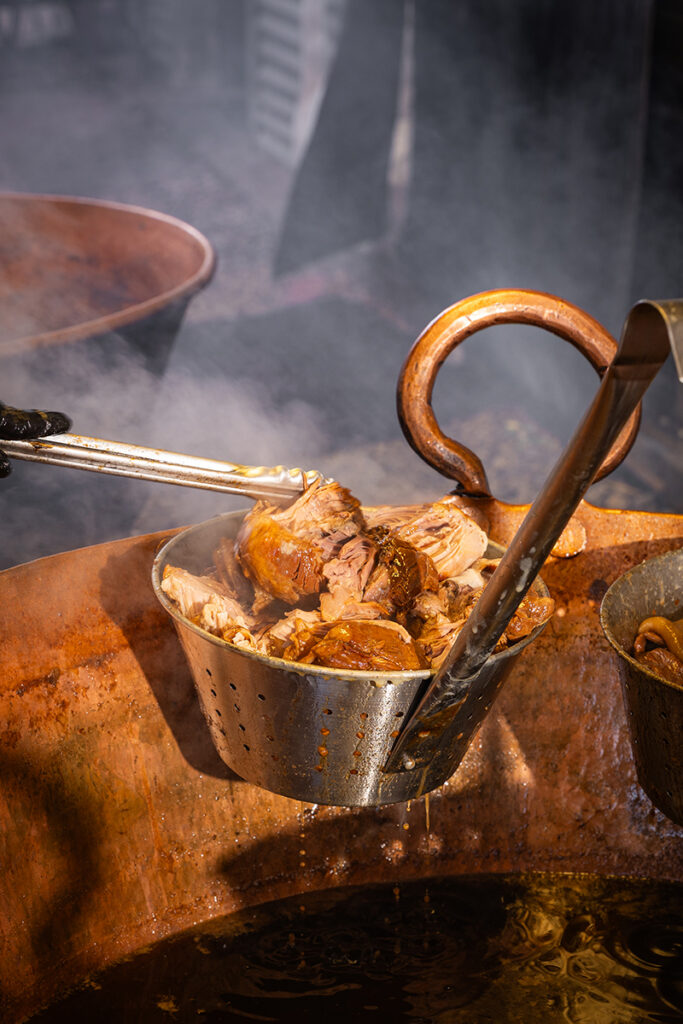
What sets their carnitas apart from any other in the city? A cooking method that involves a massive copper pot (so big that it takes six months to ship from Mexico) and an entire pig.

Many restaurants rely on gas or propane for speed and control. At Carnitas El Bigatón, everything is cooked over an open hardwood fire using oak and a touch of cherry wood. The process begins long before customers arrive. Prep starts midweek with produce and ingredients. But the real work begins early Saturday morning.
“We’re there by 1:30 in the morning,” Juan Jr. says. “The fire has to be on. We cook with wood—no propane, no gas.”
The large copper pots allow for even heat distribution. The pork simmers gently into the lard without burning. The results are a perfectly tender interior and crispy exterior. Juan, Juan Jr. or whoever is manning the pork adds different cuts in timed stages. First the pig shoulder, then stomach, ribs and the rest of the components, each spaced about 30 minutes apart. Unlike many cooks who consistently stir their meat, the Arceos’ technique is more restrained.
“We don’t keep mixing it,” Juan Jr. says. “We drop the meat in and let it cook. We don’t touch it. The paddle is only there to lift it when it’s ready.”

When you order at the counter, you’ll see someone using a large cleaver to dice the meat, pork skin and stomach, delivering a richer, more traditional style, similar to what you might see in Michoacán, a state in west-central Mexico.
If you’re new, you’ll be offered a free sample before ordering, a step the Arceos consider essential to the experience. Your order will be taken in line or at the front of the line. Along with carnitas, you’ll get fresh tortillas for tacos, nopales (prickly pear cactus), homemade salsas and vegetable toppings, all prepared in house. There’s also tortas and menudo. This summer, the Arceos plan to add chicken carnitas as well for those who don’t eat pork. Expect to wait in a line each weekend when you visit.
“We see people coming back almost every week—big restaurant people, too,” Juan Jr. says. “That surprises me. You build friendships from that.”
Despite the growth, the Arceo family’s philosophy remains the same.
“We do everything with love,” Juan Jr. says. “If you’re not doing it with love, it’s not going to come out right.”