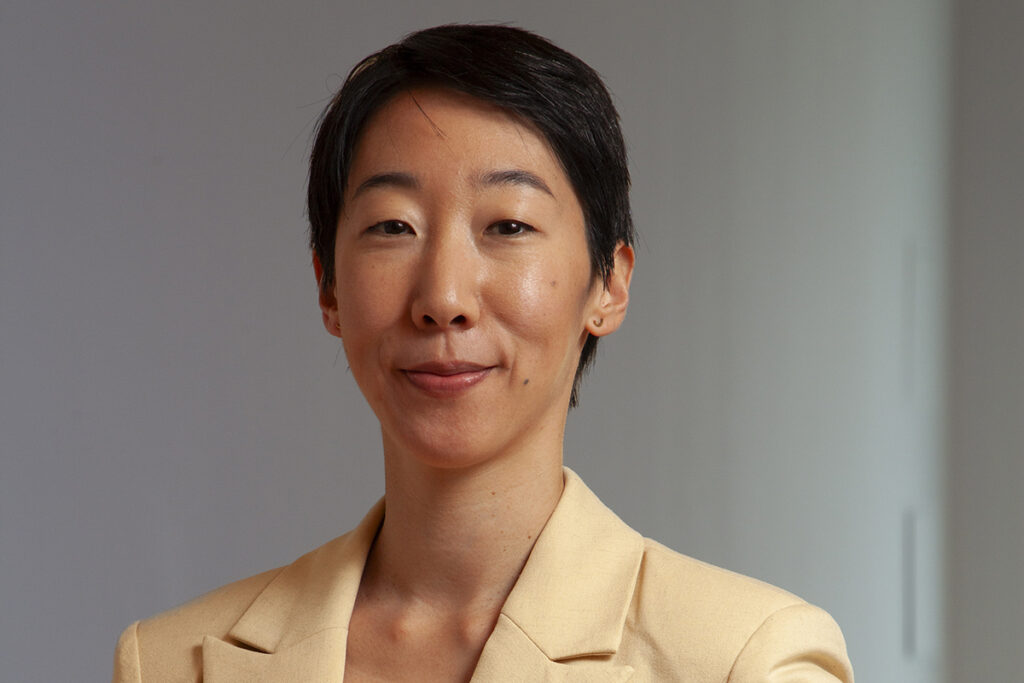
More people watch the FIFA World Cup championship than any other sporting event in the world. As Kansas City readies itself to host some of the 2026 matches, the Kemper Museum of Contemporary Art is responding in kind. Jessica Hong began her role as the Kemper’s chief curator last year, bringing with her decades of experience from the Toledo Museum of Art, Dartmouth’s Hood Museum of Art and many other prestigious institutions. Her impressive resume focuses on highlighting under-recognized narratives, a skill set that seems particularly well suited to the development of the museum’s upcoming exhibit, “The World in Kansas City.”
Kansas City magazine spoke with Hong to learn more about the World Cup-inspired exhibit ahead of its March 6 opening.
How does one get into a career in museum curation? It was quite a circuitous path. When I went to college in New York City, I thought I would have a career in diplomacy. My first internship was actually at an organization with the United Nations. Art history class in college was this very stereotypical enlightenment experience where I realized that all of the things that fascinated me—the political, the social and the cultural—entwine. It’s the arts that really create space to kind of mind all of that and artists that really shape this dynamic place in which we can explore some critical issues. That’s where I found an opening and spent the last two decades maneuvering through and finding museums. Museums have been a vital space where community, artists and arts intersect.
How did the Kemper’s next exhibit, “The World in Kansas City,” come to be? I was doing studio visits and meeting artists that were living here from all around the world, which, frankly, as a newcomer, surprised me. That led me to dig into the complicated migration histories of how Kansas City came to be over the centuries. It also made me recognize that the city is, in fact, a global city. The constituencies continue to shift and evolve. I wanted to celebrate this complicated and incredibly rich global fabric that already exists within the context of the World Cup. The exhibit features artists with global backgrounds who have lived, worked or been inspired here. But most importantly, their works and practices explore interconnected systems, ideas and experiences, crossing boundaries and truly connecting us in multiple dimensions. This works to emphasize how we all belong to a shared, complicated and nuanced social and cultural fabric.
What are the museum’s hopes about getting out-of-town visitors into the exhibit, and what are they doing to inspire that? We want everybody to come, not only the folks that are visiting. I think what I’m really excited about is that, while it is celebrating the global spirit, it simultaneously celebrates our local arts community. Most of the artists are still living here, and throughout the run of the show, we’re doing programming with them to enhance and expound upon the conversations that are happening in the galleries.
When you’re curating an exhibit like this, do you start with a goal, or do you start with pieces that inform the result? As a newcomer to not only the Kemper Museum but to Kansas City, it was important for me to get a sense of what conversations were happening in the collection in addition to the legacy and history of the museum. Thinking about the institutional vision, mission and values is always the starting point. From that, there’s often a kernel of an idea to explore. I don’t like being prescriptive. I think it’s important to lead with intuition but also not to project an idea. If you ensure that it grows organically, those shows have the most possibility for audiences to discover, be inspired, learn and appreciate.
Is it difficult to balance star pieces versus pieces that may better speak to each other? I think with group exhibitions such as this, where there is a broader theme, it’s important to highlight artists’ distinct practices. We include all of the artists’ voices in one way or another. There’s no hierarchy to the exhibition. I think what is wonderful are the conversations that happen amongst works. I like to think about how an exhibition lives after it opens. It’s the visitors that come in with their own experiences, their perspectives and who can see something in a work that I may not necessarily have seen before.