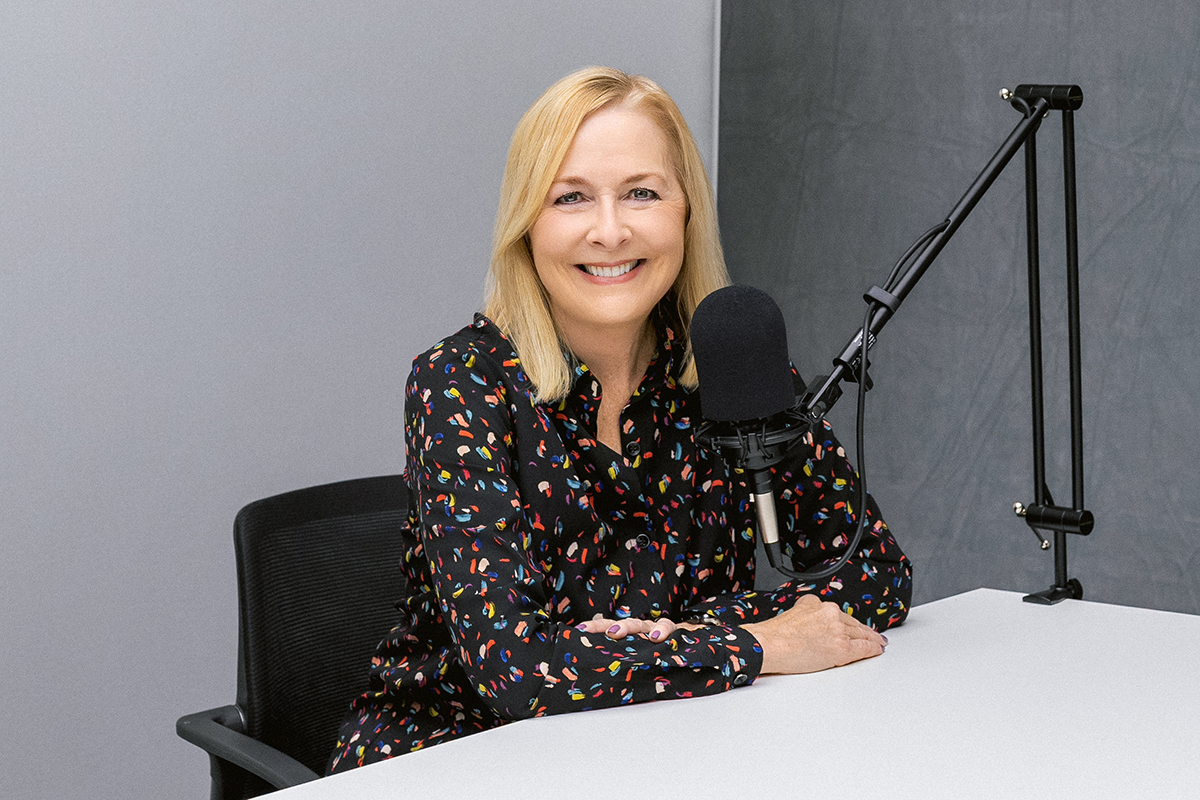
Alyx Jacobs can look at your most beloved, beat-up pair of jeans and see what you can’t: a 10-minute fix.
That ability—to assess damage quickly and imagine a garment’s second or third life—has become the foundation of her clothing repair business. And Jacobs works from a simple belief: We already have enough.
“I wholeheartedly believe that there are enough clothes on the planet that nobody ever has to buy anything new again,” Jacobs says. “But I know that that’s just not the way that the world works.”
A 2016 graduate of the Kansas City Art Institute with a degree in graphic design, Jacobs didn’t set out to be a garment repair specialist. She stumbled into it through a junior-year quilting elective where a visiting instructor from Los Angeles introduced her to boro, the Japanese art of visible mending. At the time, Jacobs was living what she calls a “pretty strict” sustainable lifestyle, toting reusable jars to coffee shops and avoiding purchasing new clothing. In fact, since 2016, she’s purchased almost no new clothing, opting instead for thrifted and vintage pieces.
What began as a personal philosophy became a business, and it’s only growing following a recent move into a storefront at 6 Westport Road. Last year, Jacobs’ team completed more than 1,500 pieces. The work is roughly an even split between alterations and mending, but Jacobs is careful to keep repair at the heart of what she does. She’s even become a contracted vendor for Patagonia’s Worn Wear program, the outdoor company’s flagship repair initiative that offers lifetime warranties on products and hosts free public mending events where customers can bring in any garment to be fixed on the spot.
Jacobs’ mending work varies, but a big part of her business includes repairing heirloom quilts, sometimes sourcing fabric from the early 1900s to match the original. “That is kind of the beauty of a quilt, specifically,” she says. “It was generally made by women, and they would use clothes that the family members had grown out of or had holes in. Then throughout the years, you would repair the quilt with the next generation’s clothes.” For one particularly meaningful project, a client wanted to repair her grandmother’s quilt, and Jacobs asked the client to provide outgrown children’s clothes for it, continuing the generational tradition of mending with family fabric.
She also restores valuable vintage pieces for sellers and performs invisible denim repairs for customers across the country, and she recently added another branch to the business: chain stitch embroidery. She uses a machine from the 1960s (designed in the early 1900s) to add custom lettering and hand-drawn illustrations to jackets and wedding banners.
Invisible repairs draw on a different set of skills, involving problem solving as much as art. You have to understand construction, anticipate stress points and think several wears into the future. But Jacobs has found that clients are refreshingly open to visible mending. “Oftentimes people will come in and they’re just like: ‘Do whatever you want. I love what I see, so just do what you want,’” she says. But she’s learned to ask for parameters, as too much freedom can be overwhelming. She’ll sometimes scroll through a client’s Instagram to understand their color preferences, determined that they’ll “walk away feeling really excited about the repair.”
“Is mending future-proof?” Jacobs says. “Is it recession-proof? I still believe that it fully is because it’s one of those things that will never be able to be automated.” She also knows the fashion industry’s math: making new clothes is still cheaper than fixing old ones. But for the growing number of people who want their clothes to last, Jacobs is proving that repair is worth the investment. Book appointments at alyxjacobsrepair.com.