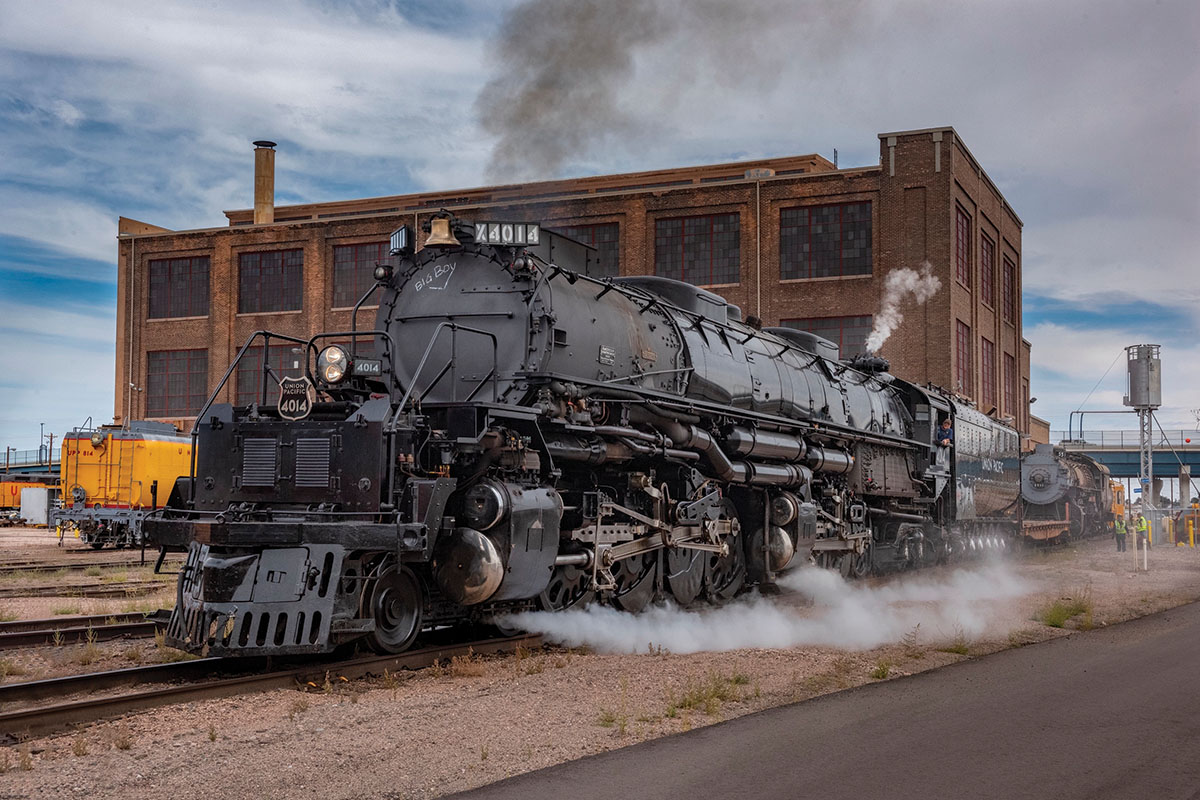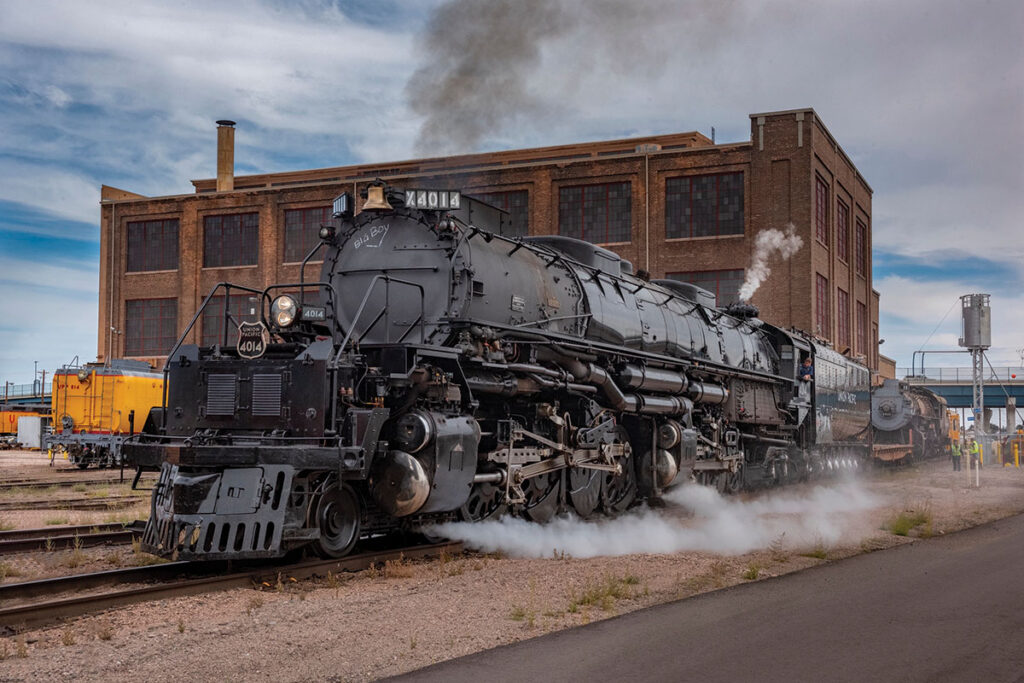
A 1.18-million-pound hulking monster of a steam locomotive will come hissing and chug-chugging right out of the history books and straight into Kansas City’s Union Station.
The 16.4-foot-tall locomotive is half as long as a football field and will be here for a three-day stopover beginning July 21. The aptly named Big Boy number 1014 locomotive is the largest operating steam locomotive in the world. Built out of cast iron, copper, brass and steel, the locomotive was converted from coal-power to diesel fuel and has a steam whistle that can be heard up to five miles away.
Big Boy is one of 25 huge locomotives that were commissioned in 1941. Engineered to pull 120-car, 3,800-ton freight trains at 40 miles per hour through the mountains of Utah and Wyoming, the engines were originally built to transport heavy equipment more efficiently in support of the 1940s war effort.
Locomotive engineers fired up its 6,200 horsepower engine in Cheyenne, Wyoming, for the first leg of the tour on May 25. Clack-clacking its way west to east across the country, then looping back west again, it will end up back in Cheyenne on July 29 after a ten-state, 80-city tour. It’s all part of the 250th celebration of the country’s independence.
Big Boy was built by American Locomotive Company in Schenectady, New York, for the Union Pacific railroad, and retired in 1961 after traveling more than 1 million miles. It was stored for 50 years in the RailGiants Museum in Pomona, California, then transferred to Cheyenne, Wyoming, where it was restored in 2019.
“It was originally going to be called the Wasatch locomotive series,” Mike Jaixen, senior manager of communications for the Union Pacific, told Kansas City. “As the first one pulled out of the factory, somebody decided—and whoever it was is lost to history —all right, whew, that’s a big boy. And that nickname stuck.”
Coordinating logistics for the locomotive’s tour has been a “very intensive process,” Jaixen says. “We’ve had to go out and primarily inspect curves and bridges just to make sure we’re good to operate Big Boy,” he says. “It’s not a question of weight support stuff, but it’s really just a matter of making sure we’ve got the proper clearance to operate a locomotive the size of the Big Boy.”
Crowds of up to 60,000 or more are expected at the various whistle stops. On board tours will be allowed at some stops, but not Kansas City.
Kansas City’s railroad history is deep and rich. Union Station handled more than 72,000 trains by 1945, much of it due to soldiers traversing the country to and from deployments and other war-related materials transport.
A significant population of Mexican immigrant railroad workers settled on the west side of KC and in the nearby Argentine district in the early 1900s, according to historian Jeffrey Marcos Garcilazo. Some lived in converted train boxcars. They worked in the railyard, but some of the earliest Mexican immigrants actually helped build Union Station, according to an article about the west side in PBS’s Flatland.
“Big Boy signifies a historical reference of big American industrial might and what makes America the greatest country on earth,” Jaixen says. “Big Boy is an excellent example of just what America can create.”
Big Boy number 1014 is “an American icon that you really don’t see anywhere else,” says Justin Lambrecht, director of education for the National Railroad Museum. “It just has that charisma about it. It’s a culmination of our country’s history and a culmination of railroading history,” he says. “We’re coming up on 200 years of railroading here in the United States, and this is an opportunity to see history up close.”
Even if you are not into locomotives, Big Boy is cool, Lambrecht says. “It just really shows the know-how of our country and that spirit to really just keep moving forward.”
For more information visit, up.com.