Before Prohibition, breweries both small and mighty seized opportunity in a climate of ceaseless social change and fierce regional competition. Author Pete Dulin’s Kansas City Beer: A History of Brewing in the Heartland explores local breweries that operated from the mid-1800s to 2016, when the book was published. Updated slightly based on recent research, these book excerpts highlight two breweries from the city’s earliest years.
1850s: Kansas City Brewery (aka Third Street Brewery)
Kansas City’s population grew in 1846 from 700 to 5,185 residents by the end of 1857. By then, the Town of Kansas incorporated as the City of Kansas in 1853 and eventually became known as Kansas City. The city had two unidentified breweries, based on records cited in C.C. Spalding’s Annals of the City of Kansas and the Great Western Plains. By comparison, St. Louis was home to 24 breweries by 1854 and reached 40 breweries six years later, with a collective annual output of 189,400 gallons of beer. These breweries employed hundreds of German immigrants, beer gardens flourished, and lager became the emerging beer style of choice. To the west, brewing in Kansas City would not fully get underway until the mid- to late 1850s.
Peter John Schwitzgebel opened the oldest known brewery in Kansas City sometime in the late 1850s. Schwitzgebel, born in Mannheim, Baden, Germany, and his wife, Wilhelmina “Minnie” Hoehle Schwitzgebel, moved from St. Louis to Kansas City in 1855. By 1860, he operated Kansas City Brewery between Oak and Market Streets (now Grand Avenue) near the East Levee.
Eager to drum up business, Schwitzgebel placed an advertisement in the Kansas City Daily Journal dated August 8, 1865, that boldly declared, “I am prepared to furnish the public with the best lager beer made west of St. Louis; also white beer, ale, and porter,” having “secured the services of a Pittsburg brewer.” By 1869, the business was called Third Street Brewery.
The 1870 Kansas City Business Directory recorded that by the end of the previous year, proprietor “Peter Schwitzgable [sic]” had manufactured five thousand barrels of beer, valued at $65,000, and employed eight workers. The entry stated, “This brewery is the oldest in the city, its lager is famous for its fine flavor and rich taste. It stands in high reputation among the connoisseurs of this agreeable beverage.”
According to a report in the Daily Journal of Commerce of Kansas City dated February 26, 1870, Schwitzgebel employed 10 men, which included his son, Otto, and used three wagons. He had about $50,000 invested in the brewery, which had a capacity of 45 barrels per day, one-third of which was consumed in the city. The daily production capacity of the expanded brewery’s malt house was one hundred bushels. The same issue of the journal lists an advertisement for P. Schwitzgebel, Proprietor of Kansas City Brewery, for beer and lager.
In 1871, Schwitzgebel changed the brewery’s name back to Kansas City Brewery. His wife, mother of six children, died in October of that year. He lost his property in 1872 in advance of the Panic of 1873, when Jay Cooke and Company, a banking firm that led U.S. government investment in railroad construction, closed its doors. Schwitzgebel’s loss was one of many casualties as a major economic panic swept the U.S. The brewery’s listing in the 1875 city directory shows Kansas City Brewing Company with Clark and Kump as proprietors.
Schwitzgebel married Katherine Homrighausen and fathered three more children before his death in 1882. By then, Schwitzgebel’s claim of producing the city’s best lager was challenged by an influx of German and Swiss brewers in Kansas City.
1884: Ferdinand Heim Brewing Company, Bavarian Brewing Company and Kansas City Breweries Company
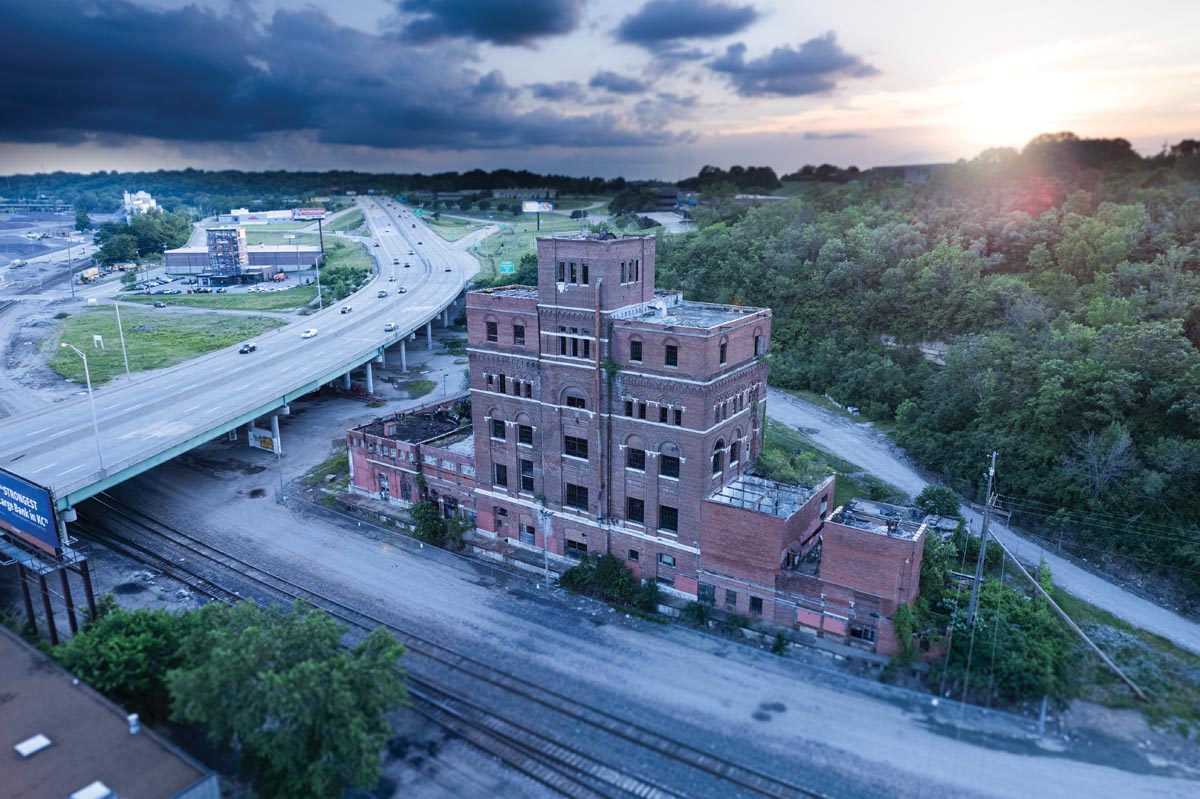
Ferdinand Heim Sr. of St. Louis–based Heim Brewery came to Kansas City with his three sons, Ferd Jr., Michael and Joseph, and brewery foreman Phillip Koppf on a mission. The group inspected the Star Ale Brewery, owned by F.H. Kumpf & Company and located at 14th and Main streets. Heim purchased the operation, the largest brewery in Kansas City at the time, with an annual production of 12,000 barrels. The company continued operations as the newly formed Ferd. Heim Brewing Company.
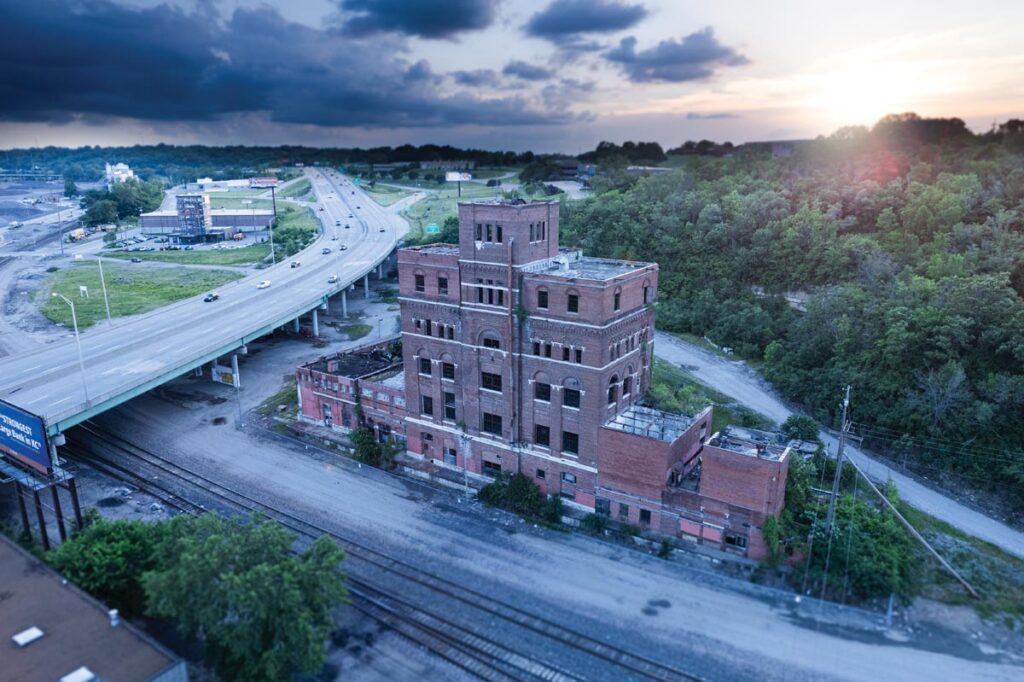
In 1887, Heim purchased a sugar refinery and acreage in the East Bottoms and built a new brewery on the northeast corner of Guinotte Street at Agnes. The 14-acre site included a malt house, elevator and large ice and refrigeration plants. This site later became the setting for Electric Park, an amusement park and beer garden.
The brewery shipped beer on company-owned refrigerator cars, using railroad tracks on company property, to towns and cities through the Midwest. Stock house No. 2 housed a vat with a capacity of 10,000 kegs, the largest storage vessel for beer in the world at the time.

Kansas City Beer: A History of Brewing in the Heartland? Visit arcadiapublishing.com
In about 1890, the former Kumpf plant at 14th and Main was eventually sold and renamed Bavarian Brewing Company. Michael G. Heim led the brewery as president. It closed in 1894, after yearly sales dropped to 18,000 barrels. Production of Bavarian’s Kyffhauser and Baierisch brands were shifted to the new Heim brewery in the East Bottoms.
Heim Brewing produced a number of brands, including Heim’s Scharnagel Select aimed at a female audience, Hedderman’s Cream beer, stronger bohemian Kyffhauser and the upscale Heim’s Wisconsin Club. By 1890, sales jumped to nearly 60,000 barrels. A Hop Tea Tonic was produced as a non-intoxicating beverage for distribution in Kansas, where the state’s 1881 Prohibition law curtailed beer sales.
In 1889, Ferd Heim Sr. sold the original Heim Brewery Company in East St. Louis, originally launched in 1870, to the St. Louis Brewing Association. The family concentrated its resources in Kansas City. Brewmaster Koppf, who had moved from East St. Louis to Kansas City, oversaw production at Heim’s Kansas City operation until his death in 1899.
Ferd Sr. passed away in October 1895. Eldest son Joseph managed the company as president, and Ferd Jr. was corporate secretary while Michael acted as plant superintendent of the Heim Brewing Co.
Heim depots were established in Des Moines and other cities. The East Bottoms brewery grew when two additional brick buildings were added along with a new engine house and five-story stock house. The Heims also built Heim No. 20, a firehouse, on the property as a safety measure. The brewery experienced two fires in 1896 and another in 1899 in the bottling works. By 1898, the brewery had installed 300-ton and 400-ton refrigeration machines. A 100-ton ice plant was also located on site. By 1899, Heim Brewing’s annual production surpassed 120,000 barrels.
Michael Heim spearheaded the idea for Electric Park, an amusement park known for its light displays after dark. Construction began in 1896, and the project was completed three years later. Electric Park operated until 1906. At the time, electric lights were still a novel luxury and part of the amusement park’s allure. Admission was 10 cents.
The park resembled the Vatican Gardens that Joseph Heim had once visited on a trip to Italy. This entertainment complex offered picnic tables, band concerts, bathing facilities, boating, roller coaster rides and a vaudeville and opera theater that seated 2,800. Naturally, Heim’s beer was served to the public in a German-style beer garden piped directly from the brewery. In 1907, Electric Park was dismantled and moved to the corner of 47th and Paseo. This version of the park, illuminated with more than 100,000 electric light bulbs, burned to the ground in 1925.
An 1897 article in Electrical Review reports that the East Side Electric Railway Company filed articles of incorporation with the State of Missouri. The stockholders were Joseph Heim, Ferd Heim, Michael Heim and C.S. Palmer. Managed by the Heim brothers, the railway operated along an electric line on East Fifth Street from Walnut Street (in today’s River Market) to Lydia Avenue. The line continued north to Guinotte Avenue and east to Otis Avenue, which was within a block of Heim’s brewery, and north again to Nicholson Avenue.
The Heim brothers also commissioned the building of a road, North Montgall Avenue, that connected Guinotte at the south end and Nicholson Avenue to the north. Contemporary butcher shop Local Pig once sat at the corner of Guinotte and North Montgall. Originally, a powerhouse for a double-track railway was located at the opposite end of the road at Nicholson and North Montgall. This station and generators at the brewery powered the railway. Allegedly, the Fifth Street line was intended to transport workers from nearby downtown homes to the plant, but workers didn’t want to pay the toll. The streetcar line proved more successful and profitable as a means to transport adventure-seekers to Electric Park.
In 1900, Heim Brewing constructed a modern two-story bottling building, designed by architect Charles A. Smith, at 507 North Montgall that still stands. A pipeline connected the bottling building to the brewery. By then, the brewery was the largest in Kansas City. A fire in 1901 completely ruined an icehouse, but the brewery continued operations, employed 250 people and expanded capacity to 150,000 barrels per year.
More disasters struck in the following years. The Heim brewery and much of Kansas City suffered great damage when the Kansas River breached its banks on May 30, 1903, and flooded the river bottoms. The aftermath of the flood resulted in 19 deaths. Over 23,000 people lost their homes, 16 of 17 bridges were destroyed, more than 200 taverns were flooded, and total damages ran approximately $22 million.
More changes ensued as a merger swept through Kansas City’s brewery industry. A group of Cleveland investors formed Kansas City Breweries Company (1010 Commerce building) in 1905, consolidating Heim Brewing, Rochester Brewing Company (also known as the J.D. Iler Brewing Company) and Imperial Brewing Company. The combined capacity of the breweries rivaled Muehlebach Brewing. However, operational troubles were in store for Kansas City Breweries Company, riddled with debt after the Imperial Brewing acquisition and about to face Prohibition.
World War I and anti-alcohol sentiment took a toll on breweries. Congress passed the temporary Wartime Prohibition Act in November 1918, banning the sale of alcoholic beverages with alcohol content greater than 2.75 percent. The act was an attempt to preserve grain for use as food. Next, Prohibition spurred the demise of Heim Brewing’s operations in Kansas City and St. Louis. Each operation was eventually sold to separate ice companies.
Few buildings remain from Heim’s presence in Kansas City. The Bavarian Brewery was torn down and replaced by a carriage factory shortly after 1894. The land at 14th and Main was later used to erect a store and three apartment buildings. These buildings were razed to make room in 1921 for the vaudeville and movie house Main Street Theater. The theater changed ownership and names several times, becoming the RKO Missouri Theater in 1941, Empire Theater in 1960 and AMC Main Street Theater in 2009. Between 2012 to 2021, Alamo Drafthouse, a movie theater chain known for its selection of craft beer, operated its Mainstreet location on or near the spot where beer was once brewed.
The Heim bottling department on Montgall in the East Bottoms was once home to former distributor and wholesaler Case Supply. The Heim No. 20 Fire Station, built in 1903, still sits at the corner of Guinotte and North Montgall.
J. Rieger and Co., a distillery operated by Andy Rieger and Ryan Maybee, acquired the former beer bottling plant. After extensive renovation, by 2019 the site became J. Rieger’s headquarters, the base of distilling operations and an entertainment destination with an outdoor space dubbed Electric Park Garden Bar as an homage to the site’s history. A curated museum exhibit details the history of the Heim family, brewery and original Electric Park. The distillery also serves Heim Bier, a lager produced by Kansas City Bier Company, that pays tribute to the Austrian-Bohemian heritage of the Heim Family.