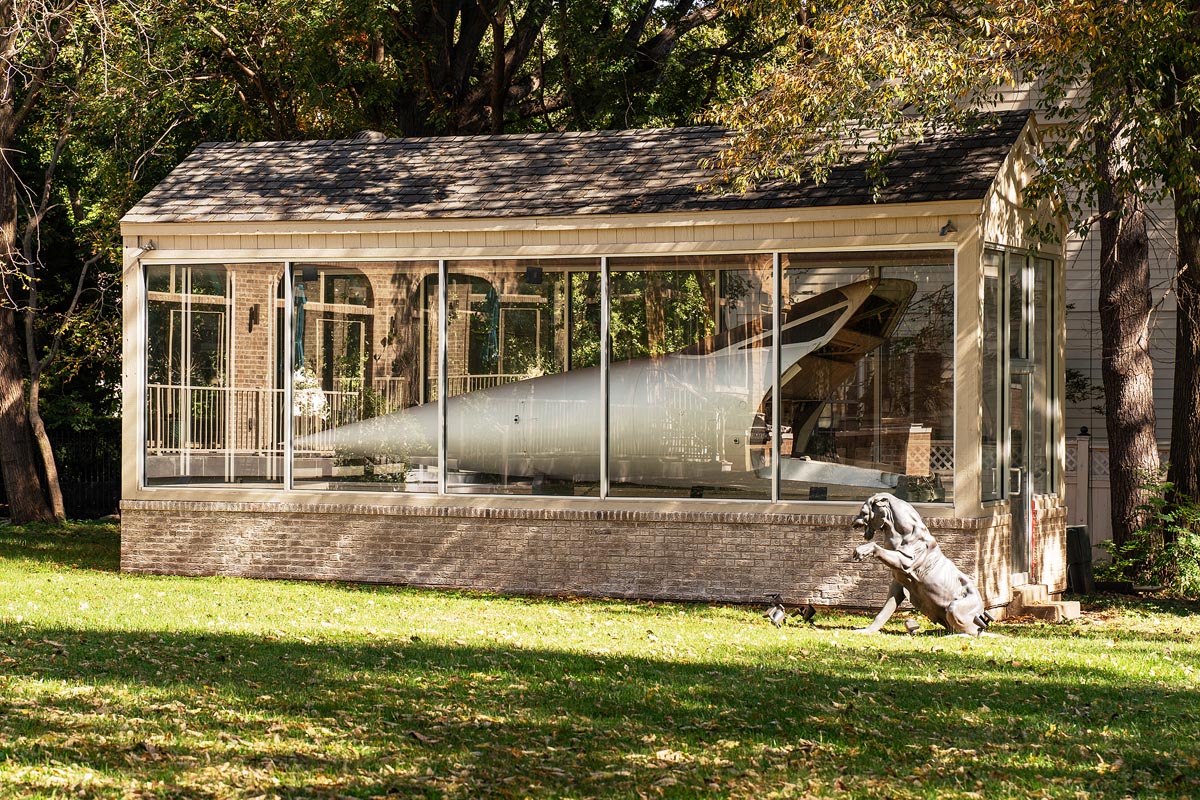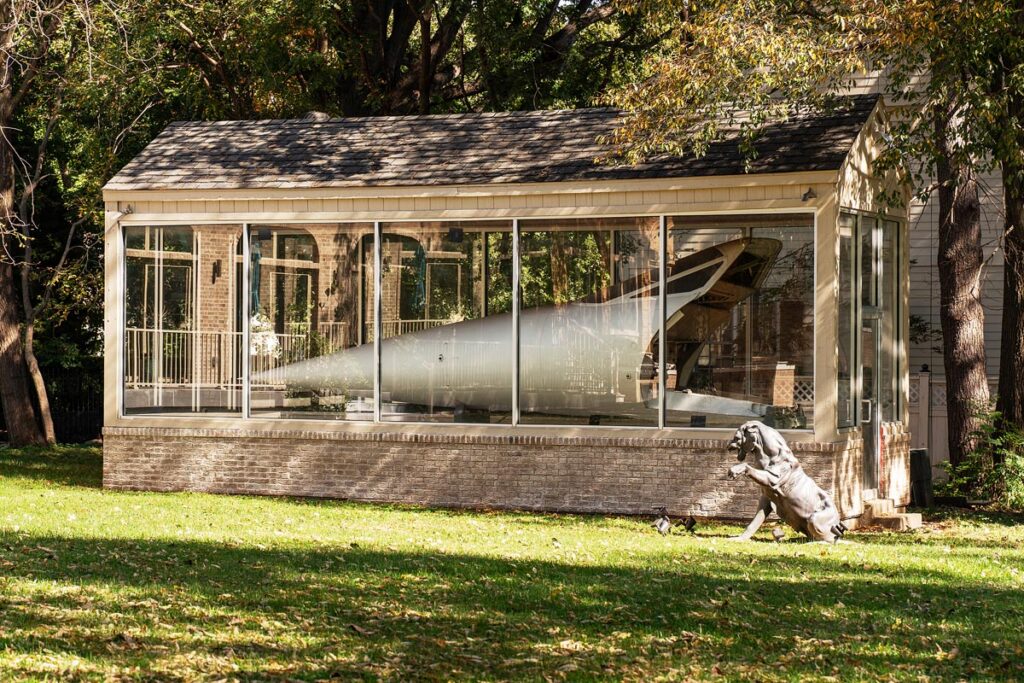
Blink and you’ll miss it: the nose of an airplane sitting inside a glass case in the backyard of a home on Ward Parkway. But this isn’t just any airplane nose; it’s the tip of a Concorde, a plane that could travel twice the speed of sound.
The display belongs to Farhad Azima, an aviation entrepreneur whose career began in the 1970s transporting cattle by air from the U.S. to the Middle East. In the 1980s, Azima moved into passenger aviation, founding ALG Transportation, an aircraft-leasing company, according to his official biography.
In a 2019 story for Flatland KC, Azima said he purchased the nose at a London auction in the 1990s. When asked why he wanted it, he said: “I want to be buried in it.” (Kansas City magazine reached out to Azima for comment but didn’t receive a response.)
According to Paul Evans, founder of the International Concorde Tour Group, the piece came from Air France Concorde F-BVFD, nicknamed “Fox Delta.” The plane was retired after Air France discontinued its Paris-Dakar-Rio route, and it also had some structural damage following a hard landing in Dakar, Senegal, in November 1977. “The touchdown rate was recorded at 14 feet per second, exceeding the standard 10 feet per second limit, resulting in damage to the rear tail bumper wheel.”
After spending 12 years out of service, the plane was dismantled at Paris’ Charles de Gaulle Airport in 1994. “By that time, extensive outdoor storage had resulted in significant corrosion throughout the airframe,” Evans says.
Records show that on March 16, 1995, the nose assembly sold to a private American buyer for 300,000 French francs, equivalent to approximately $57,000 at the time. The rest of the Concorde was moved to Dugny, France, near Le Bourget Airport, where parts of the aircraft can still be seen.
Only 20 Concordes were built, and 14 entered commercial service, according to the Smithsonian National Air and Space Museum. Capable of flying twice the speed of sound, the supersonic jets could cross the Atlantic in less than four hours. Commercial Concorde service ended in 2003.
For most collectors, preserving pieces of aviation history is not unlike collecting art or vintage cars. According to Ted Huetter, senior public relations and promotion manager at the Museum of Flight in Seattle, “I don’t see it much different than any other passion for collecting,” he says. “It’s just that the artifacts are usually bigger and expensive.” The Museum of Flight’s collection includes everything from aircraft parts and instruments to uniforms and personal memorabilia. Many objects are kept in storage for research, loans or future display, according to the museum.
The Concorde nose on Ward Parkway, meanwhile, has its own permanent display: a glass enclosure in a backyard, preserving an important part of supersonic aviation history.