Long before digital ads or the splashy billboards along I-70, companies often turned their largest assets—their buildings—into eye-catching promotional platforms.
In the late 19th and early 20th centuries, building signage was one of the most successful advertising tools a company had. A company’s name might have been painted across the side of a brick building for potential consumers to spot from half a mile away, mounted as a large sign or carved directly into its facade, permanently marking the building’s identity.
Nowhere in Kansas City was this more visible than in the garment industry, particularly in the Garment and Crossroads Districts. The Garment District—the stretch of warehouses and storefronts on Broadway Boulevard—was a thriving fashion manufacturing hub in the early- to mid-1900s. “The rapidly growing garment district, or wholesale district, soon became the largest wholesale distribution center in the world,” wrote David Jackson and Ann Brownfield in We Were Hanging by a Thread, a book on the district’s history. “The principal items sold were clothing, dry goods, shoes, pharmaceuticals, home furnishings, paper products, millinery, caps and wholesale printing services.”
Some of these ads have stood the test of time, whether painted, pressed or etched into brick and stone. These remnants are known as “ghost signs.” “Various people love the history and like to preserve the remnants of beloved businesses and buildings,” says Lisa Shockley, curator of collections at the Museum of Kansas City, noting that some of the city’s most iconic signs endure because people have chosen to protect them. Here are five of them and the stories their walls continue to tell decades later.
Peck’s Department Store
![Peck’s Department Store 1044 Main St. “The operation that became Peck’s Department Store in 1914 opened as Doggett and Orrison in 1868,” according to We Were Hanging by a Thread. The dry goods store, which sold clothing and textiles, would later evolve into Peck’s and play a vital role in one of the city’s greatest entrepreneurial stories. “Nell [Donnelly] started in her basement and got an order for 16 dresses from Peck’s department store in 1916,” according to Jackson and Brownfield. “Reportedly, she delivered the dresses, and they sold out in three days. Then, they gave her an order for 300 dresses.” Peck’s orders effectively launched her business, which grew into the Donnelly Garment Company and its iconic Nelly Don dress line: women’s clothing that finally ditched the shapeless, potato-sack style for something wearable and attractive. In February, the Kansas City Business Journal reported that the former Peck’s Department Store building is the subject of a proposal to convert the ground level into a restaurant and commercial space, with 74 loft apartments planned on the remaining floors.](https://kansascitymag.com/wp-content/uploads/2026/03/Ghost-Signs_Peck-683x1024.jpg)
“The operation that became Peck’s Department Store in 1914 opened as Doggett and Orrison in 1868,” according to We Were Hanging by a Thread. The dry goods store, which sold clothing and textiles, would later evolve into Peck’s and play a vital role in one of the city’s greatest entrepreneurial stories.
“Nell [Donnelly] started in her basement and got an order for 16 dresses from Peck’s department store in 1916,” according to Jackson and Brownfield. “Reportedly, she delivered the dresses, and they sold out in three days. Then, they gave her an order for 300 dresses.” Peck’s orders effectively launched her business, which grew into the Donnelly Garment Company and its iconic Nelly Don dress line: women’s clothing that finally ditched the shapeless, potato-sack style for something wearable and attractive.
In February, the Kansas City Business Journal reported that the former Peck’s Department Store building is the subject of a proposal to convert the ground level into a restaurant and commercial space, with 74 loft apartments planned on the remaining floors.
Seiden’s Furs
10th Street and Broadway Boulevard
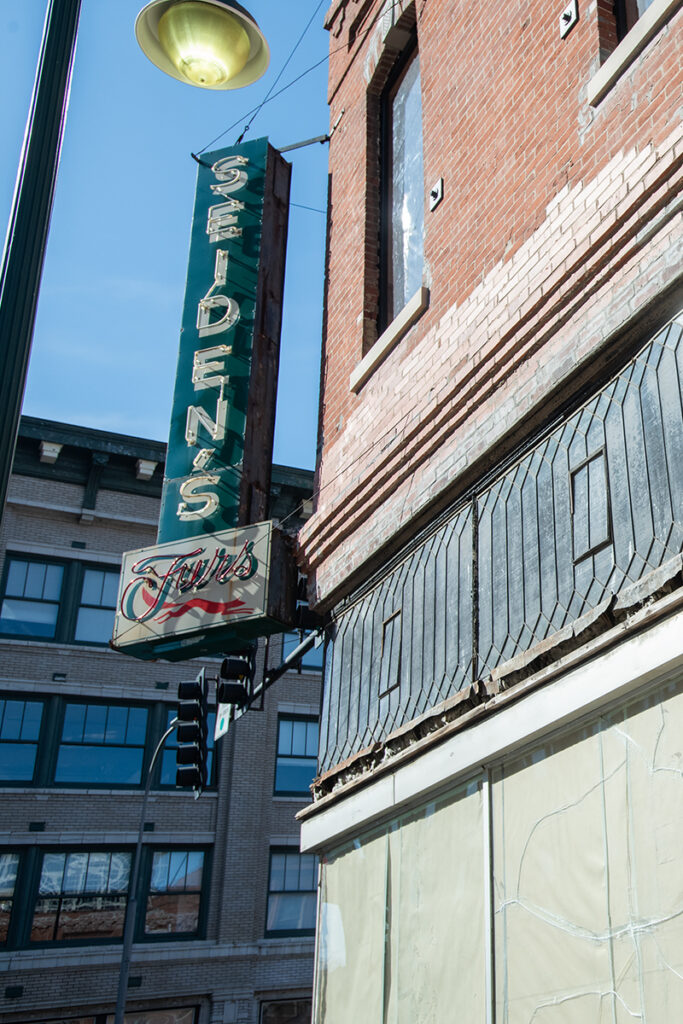
This two-story brick building that dates back to 1874 became home to Seiden’s Furs in 1935 and operated as such for more than 70 years. A 1980 architectural survey noted that the building is the oldest existing structure in Kansas City’s Central Business District.
The building’s iconic vertical sign nearly disappeared for good after a partial roof collapse in 2021 threatened demolition. A few years later, developer Chris Sally of Iconic Development stepped in to save the building, earning a 2025 Historic Kansas City Preservation Award for the effort.
The space has remained vacant, but not for long: It is slated to become Loretta Jean’s Restaurant and Bar, set to open this fall. “The objective is to preserve the history of the building as much as it is to put a restaurant in there,” chef Rick Mullins told Kansas City magazine in March. “It’s going to be loaded with artifacts and things unique to Kansas City.”
Boss Manufacturing Company Building
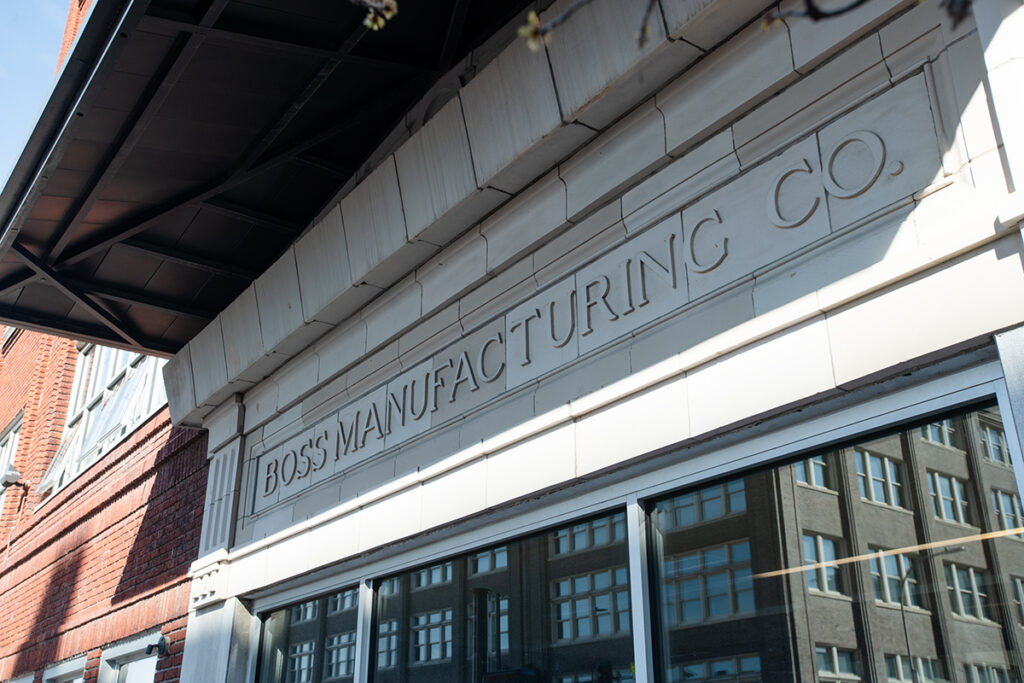
This six-story building once housed Boss Manufacturing Company, a maker of work gloves and industrial wear that helped define the garment industry’s identity in its heyday. The bold “The Boss” lettering is still visible on its exterior and is a textbook painted advertisement, designed to be read from half a block away. Above the front door, an awning bears “Boss Manufacturing Co.” engraved in stone.
By the mid-20th century, Folgers Coffee purchased the building and established a roasting plant, which operated until 2012, according to the Missouri Department of Natural Resources. Today, the building is Roaster’s Block Apartments—the branding a wink to its industrial past.
Much of the historical context in this story comes from We Were Hanging by a Thread, a detailed account of Kansas City’s Garment District by Ann Brownfield and David W. Jackson.
Emery, Bird, Thayer Warehouse
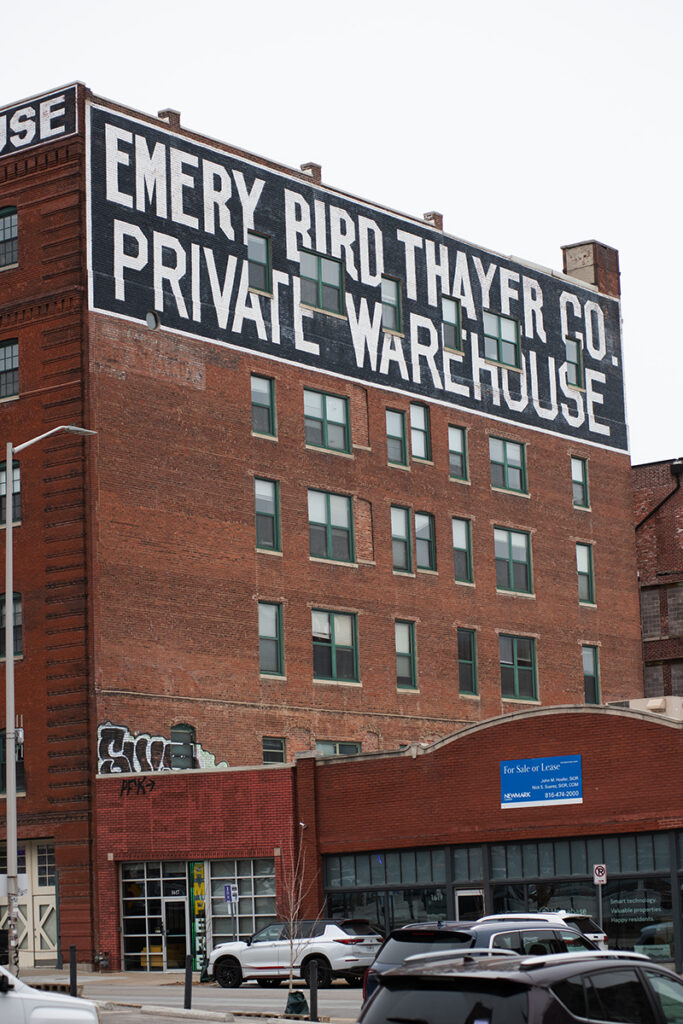
Painted across the brick of this six-story building is one of downtown’s most recognizable ghost signs: “Emery, Bird, Thayer Co.” The massive structure was erected in 1899, according to the Kansas City Public Library, as a warehouse for the Emery, Bird, Thayer department store, located several blocks from the company’s flagship store on Petticoat Lane. According to KC Loft Central, goods were stored here and distributed between the warehouse district and the busy retail corridor downtown.
The department store itself closed in 1968, but the warehouse survived and was later converted into residential lofts, now known as EBT Lofts. The sign remains visible today in part because it has been periodically repainted over the years. “Sunlight fades and kills color,” Shockley says. “To keep [the ghost signs] alive, they have to be repainted, like someone does for the old Emery, Bird, Thayer warehouse that hasn’t been used as that since 1968. If no one has a reason to maintain them—and isn’t motivated to paint over them—they slowly fade to oblivion.”
Thomas Corrigan Building
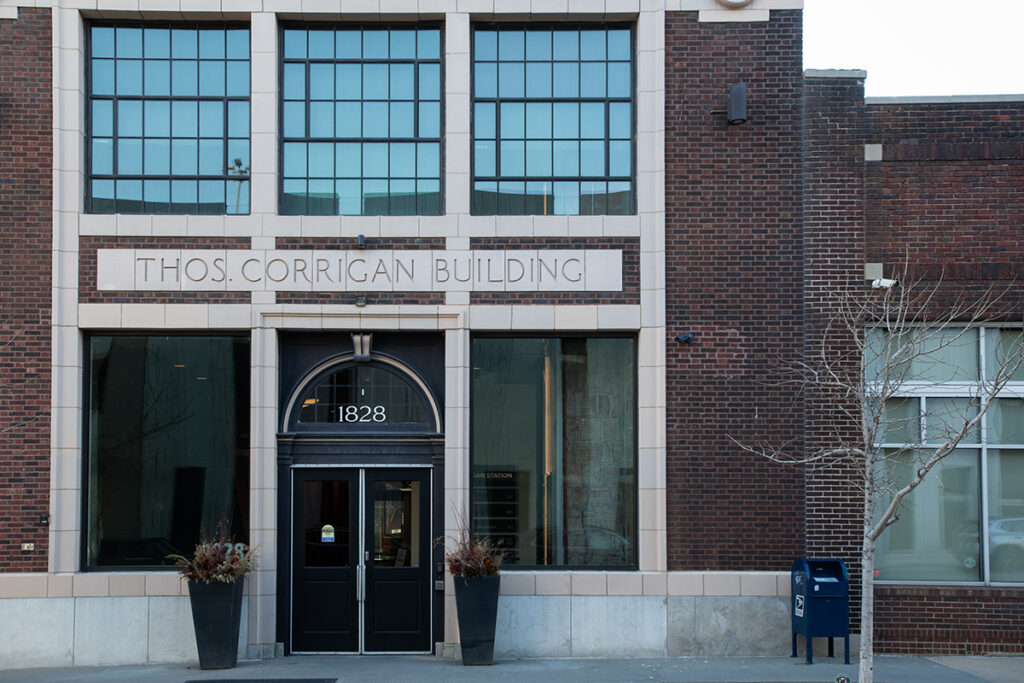
Completed in 1921 and named for Irish immigrant Thomas Corrigan, who helped establish Kansas City’s first streetcar, this 10-story building cycled through a few tenants: the Gateway Station Post Office, the Donnelly Garment Company and the Veterans Administration, among others. “Thos. Corrigan Building” is still etched above the front entrance, permanently marking the building’s namesake (Thos. is short for Thomas).
According to guided tour app Clio, from 1935 until 1947, the Donnelly Garment Company operated here during a pivotal time in its growth, eventually employing more than 1,000 people and becoming one of the largest dress manufacturers in the world.
Renovated in 2015 as Corrigan Station, the building now houses ground-floor retail and upper-floor offices. The KC Streetcar stops just outside—a reminder of the building’s ties to the city’s original public transit.