For years, Frank and Eloise Bott wrote letters to Frank Lloyd Wright.
The couple had their sights set on the architect, who happened to be the most celebrated of the 20th century, and wanted him to design their home on a bluff in Briarcliff. Wright, then in his late 80s, wasn’t easy to reach. But what finally got his attention were the photographs of the sweeping views and the topography of the hillside lot.
By late 1956, Wright wrote back, and by May 1957, he had signed and dated preliminary drawings. In 1963, the Botts’ home was ready for move-in.
The house is among the last that Wright ever completed. Homer Williams has lived there for nearly 40 years. An architect himself, he knew Frank and Eloise Bott and received the first right of refusal when the estate sold in 1987. “The rest is history,” Williams says.
Wild Side

Wright’s philosophy was “organic architecture,” or the belief that a building should feel at peace and one with nature. The Bott House is a clear expression of that idea.
Rather than sloping over the Briarcliff bluff, the house descends into it, emerging from the hillside in a way that makes it feel a part of the hill, rather than built on the topography. “Don’t build on the hill,” Wright used to say. “Buildof the hill.

Williams, who spent many years as a pilot, says he used to spot the house’s signature green roof on his descent to downtown’s Charles B. Wheeler Airport. “When I used to look down and see this green roof,” he says, “I had no idea I’d one day be here.”

From the cantilevered terrace behind the home, you’re met with 180-degree views, the city’s skyline in perfect view with the Missouri River bending to the west. “Wright wasn’t averse to using the view,” Williams says. “He did a lot of buildings where the house was located down the hill.”
A Farmer’s Fence

One of the most striking features of the home is the stone, which juts out from the walls in irregular cuts. The desert-style stonework is not unlike Wright’s own home, Taliesin West in Scottsdale. But the stone in the Bott House didn’t come from the desert—Frank Bott found it in the Flint Hills of Kansas.
“Frank Bott made an arrangement to buy a farmer’s fence about 75 miles west of here,” Williams says. Bott then replaced the farm fences with steel and hauled the stones to Briarcliff, where they were laid in forms with concrete poured around them.
“Every one of these pieces of stone that you see was put in a wall by a human somewhere around 150 years ago,” Williams says. The variation in color and texture and the rough honeycombing where concrete surrounds the stones was entirely intentional.
Wood and Light
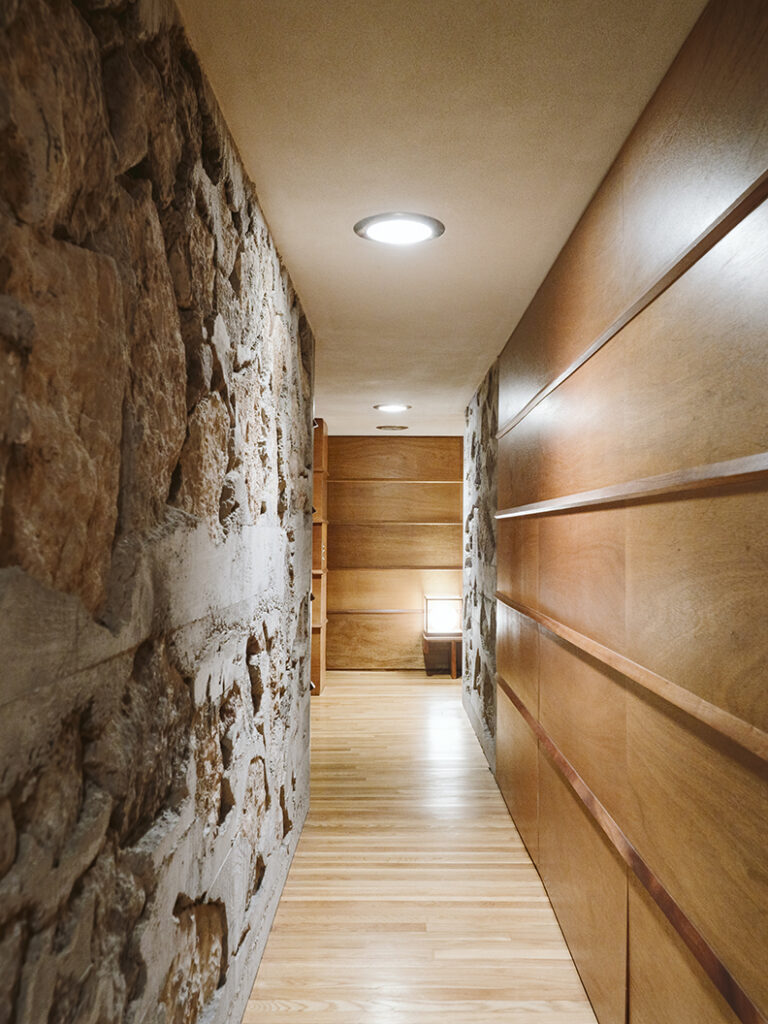
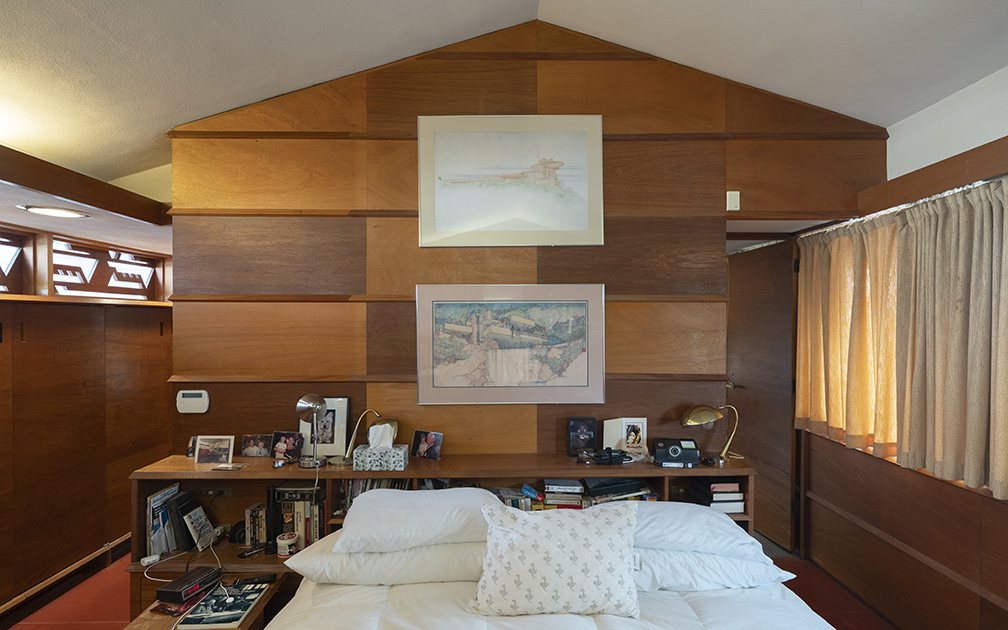
The interior is wrapped in Honduran mahogany, from walls and cabinetry to ceiling soffits and built-ins. Most of it is original, but some panels had to be replaced with Philippine mahogany after a storm, since Honduran is no longer commercially available.
Wright’s signature mitered glass corners are seen throughout the house, flooding the interior spaces with natural light. The decorative woodwork panels over the windows in the primary bedroom (a constant that Wright used in his Usonian designs), are what Williams describes as an Arizonian touch, which tracks; the Botts spent a lot of time in Scottsdale, hauling an Airstream down to the desert for weeks at a time. “We think Wright had a feeling that Arizona ought to follow them up here,” Williams says.

Leakproof
The roof’s low, horizontal ridges are inspired by Bermuda-style homes, a design feature that’s known for its tiered rooflines built to collect rainwater.
“Wright wanted a specific color, which is not what copper turns to when it oxidizes,” Williams says. “In order to get that, it had to be something that came in that color by nature. Nothing did.” The solution was terne metal, a tin-coated steel that could be painted to achieve the color that Wright was after.
Despite the roof’s seemingly rainproof design, it did pose issues over years. “The Botts knew it never didn’t leak,” Williams says. The crimped seams of the roof were no match for high-wind storms up on the bluff, and over decades, the resulting leaks threatened the woodwork and furniture inside the home.
To remedy this, Williams eventually found a PVC-based membrane whose color was, as he puts it, a dead match. Heat-welded seams, which replaced crimped joints, creating one continuous waterproof surface over the entire roof. It looks very much as Wright designed it, but with no water getting into the house.

What Remains
The furniture and built-ins are all original, as are many of the fabrics, including a blue textile with a Sally thread that Williams has spent years trying to replicate. “It’s easy to match the color,” he says. “We haven’t been able to find the texture.”
Eight antique oriental screens once lined the walls, and when Williams bought the house, he says the screens were not included. Seven are now in a private collection in Chicago; the last one’s whereabouts are unknown. “I’d have to win the lottery to get them back,” says Williams. In their place are Spanish posters from the Miró and Picasso museums in Barcelona, brought back from Williams’ own travels.

The home is full of relics beyond these, including a planter box built directly into the foundation and framed original drawings and mementos—among them are Wright’s preliminary sketches for the house and his original letter to the Botts.
GO: Tours of the Bott House are available by appointment only. Inquire via email hwilliams@wskfarch.com or by calling (816) 721-7564.