Kathy Hoggard, retired Brookside resident and certified master gardener, has been a dedicated home composter for decades. She was exposed to the idea early in life from her parents. “My mom and dad were both farm-raised, World War II-aged people who would just take kitchen scraps out and bury them in her garden, just between the rows,” she says. “So I had seen this sort of thing – it wasn’t foreign to me.”
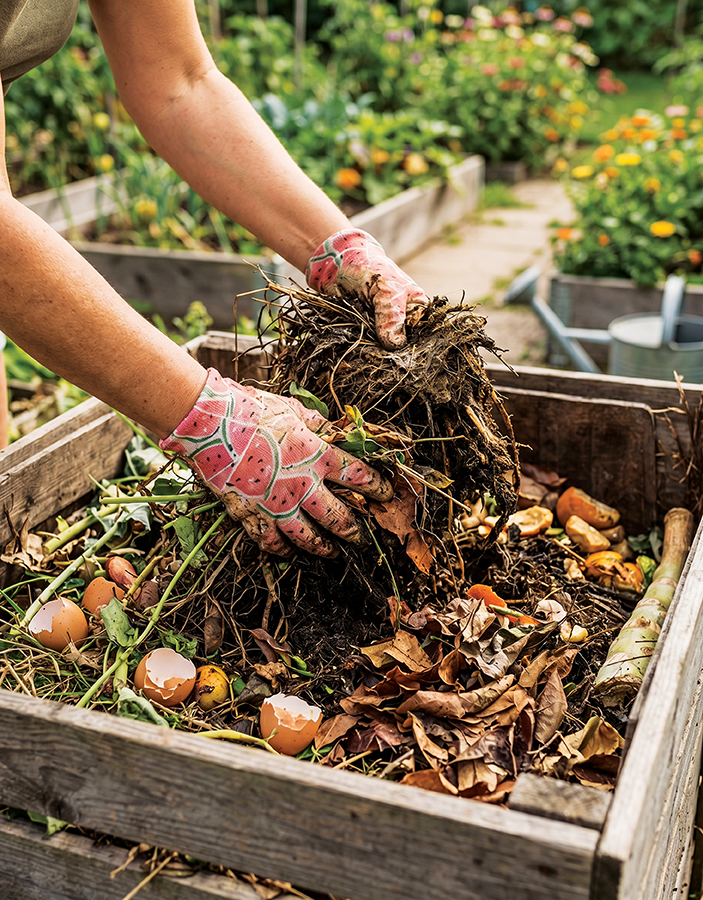
About 20 years ago, Hoggard decided to get more serious about her composting efforts. With suggestions from friends, she created her own compost method that she has used ever since. Each December, she starts a new compost pile in her backyard with layers of alfalfa pellets, shredded leaves, and water. That mixture is used as the base for her compost. “The food waste goes in all year,” Hoggard says. “I just dig a little hole, throw the food waste in, and cover it up.”
By June, the compost is ready for use. Hoggard spreads her compost on top of her flower beds and mixes it with purchased potting soil for her pots. She notes that while she doesn’t have a concrete way to prove it’s improving her garden’s bounty, fellow master gardeners have told her there’s no way she could have such a prolific garden if it weren’t for her compost. “I don’t know if that’s true or not, but it’s a fabulous way to keep what your yard produces in your yard and not have to buy something that you don’t know what’s in it,” Hoggard says. “I know everything that goes into this. It’s 100% no pesticides and no herbicides.”
Composting – or decomposing organic waste into nutrient-rich material – has gained momentum in recent years. The United States Environmental Protection Agency reports that wasted food causes 58 percent of methane emissions from municipal solid waste landfills and that “wasted food in the U.S. causes greenhouse gas emissions equivalent to those of more than 50 million gas-powered passenger vehicles.”
Composting decreases methane emissions and landfill capacity by keeping organic material out of landfills. Finished compost can act as a natural fertilizer and improve soil and water health.
Sarah Mayerhoffer, chief sustainability officer for Missouri Organics and long-time home composter, started her composting efforts in 2020. She was inspired by environmentalist Paul Hawkins’ 2017 book, Drawdown, which names reducing food waste as one of the top ways an individual can contribute to a healthier planet.
However, you don’t have to be a master gardener or chief sustainability officer to start composting. “Don’t be scared to start doing it,” Mayerhoffer says. “I’ve talked to a lot of people who are apprehensive about it, but once they start doing it, they really enjoy it. It’s fun for kids, it’s fun for people to see it’s the circle of life in a way.”
Kansas City’s chief environmental officer, Jensen Adams, says the city is focused not only on composting, but also reducing food waste from the start. Adams encourages individuals to buy only what they need so they accumulate less waste.
“Kansas City is a leader, especially in the Midwest, and especially in the state of Missouri,” says Adams. “Partly because we have a really comprehensive and coordinated network of service providers that are concerned about organic material, and it’s not just the compost part.” Adams mentioned Kanbe’s Markets and Urban Produce Push as partner organizations working to reduce food waste and increase food access to those who need it.
Kansas City, Missouri’s Climate Protection and Resiliency Plan, published in 2022, includes a strategy to “divert organic waste from the landfill through composting.” The city is taking action to expand access to composting resources by partnering with service providers and community organizations, such as Missouri Organics, KC Can Compost, and Compost Collective KC. Since 2023, The city’s composting program has collected 202,000 pounds of food waste at its collection locations – waste that otherwise would have ended up in a landfill.
Compost Collective KC, who offers farm drop off, curbside pick up, and bin-swapping for food waste, doesn’t stop at composting. “One of the phrases we use is farm to table, table to farm,” says Tony Whitter, chief executive officer for the organization. “That reflects the full circle that Compost Collective is associated with a 13.5 acre urban farm in Kansas City, Missouri, and that farm grows food for its neighbors. It’s what I consider to be an authentic social enterprise in that it serves a social good, but it’s also trying to be a viable way to make a living for somebody.”
Kristan Chamberlain, chief executive officer and co-founder of KC Can Compost, a non-profit composting organization, is thrilled that many of Kansas City’s businesses make the effort to partner with them for composting. Greendirt Farm, Nelson-Atkins Museum of Art, and Boulevard Brewing Co. are just a few examples from a long list of local businesses that are also KC Can Compost partners.
Chamberlain encourages people to start composting and notes that it isn’t hard. “It is easy to do,” she says. “Once they are set up, it becomes a simple habit – a small, everyday action that adds up to real environmental and social impact.”
Where to compost
Kansas City Composting Program
Find local Compost drop-off locations throughout the city
Compost Collective KC
816-281-7871
KC Can Compost
816-912-3286