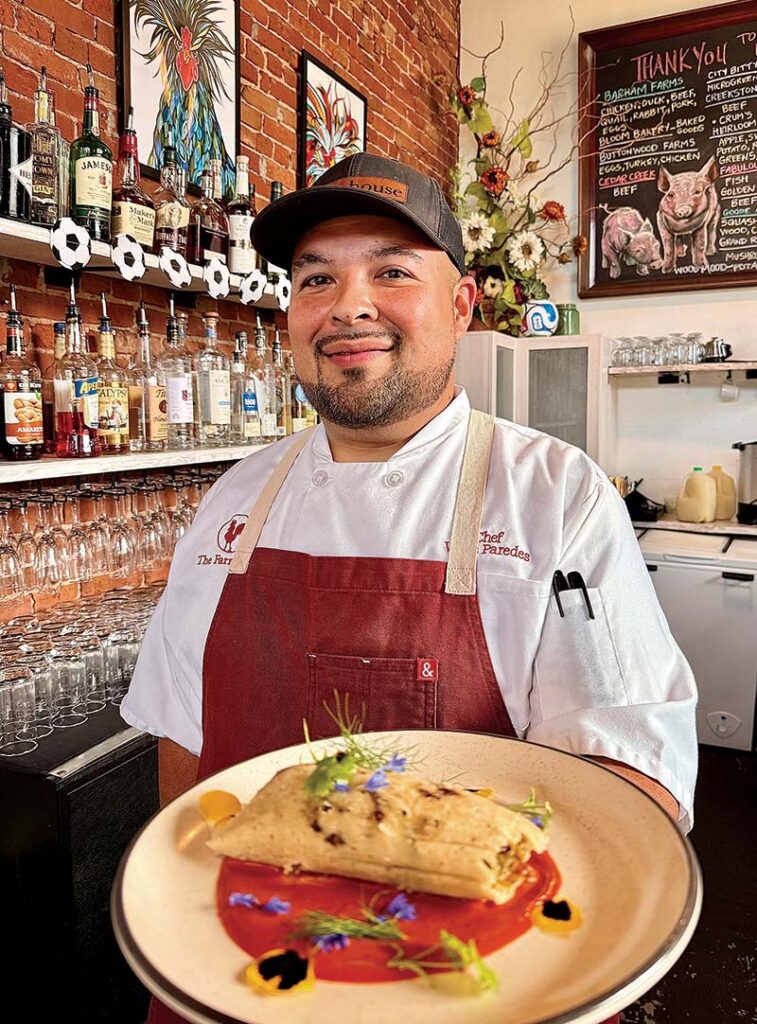
Chef Vince Paredes’ burnt end chile relleno tamale is a masterful mashup honoring local ingredients, a love of Kansas City barbecue and his family’s Mexican heritage.
Paredes, who co-owns The Farmhouse, a farm-to-table restaurant in the River Market that proudly displays a chalkboard listing of ingredient sources, seasons Barham Family Farm brisket with his own “Chicano” rub. The rub, a cross between a traditional Kansas City-style rub and a barbacoa seasoning, tastes earthy and packs the heat.
He smokes the meat over lump hardwood coal with oak and mesquite chunks in a Pit-Boss by American Barbecue Systems. The Olathe-based company also supplies the heat for Cook for Courage, a signature fundraiser for the Child Protection Center at which Paredes has won top culinary honors for six years in a row.
Paredes buys masa at Art’s Molino and Market in KCK, “where everybody who knows goes,” he says. Paredes hydrates the dough overnight with beef stock, sometimes diluted with water so it doesn’t mask the corn’s flavor. Instead of combining the masa with traditional lard, he whips bacon fat until it’s light and fluffy and has the glossy sheen of marshmallow fluff. “When you’re a brunch restaurant, you’ve got a lot of that on hand,” he says.
Paredes, who worked at Baskin-Robbins as a teen, folds the masa and bacon fat together, then uses an ice cream spade to spread the mixture on softened corn husks. To that base he adds layers of smoked gouda, queso Chihuahua and poblano peppers. Finally, he crowns his creation with cubed (rather than shredded) burnt ends “for a more typical barbecue presentation.”
“You’re going to have very authentic techniques and flavors, but this is not the way you get it in Mexico,” says Paredes, who grew up in Roeland Park but whose family is from Ario de Rosales in Michoacán. “I don’t have that background. I have it through heritage. I have it through stories. I have it passed down in recipes.”
Paredes has picked up tips for tamale making from his mother and various abuelas who have worked with him over the years, including folding a second husk over the opening to keep the burnt ends from spilling out and placing them horizontally in the steamer to better retain their rounded shape.
He learned from his grandfather to add a coin in the bottom of the steaming pot to determine the correct heat level by listening for a gentle rattle.
Paredes serves the tamales on an embellished Mexican Suiza, a vibrant orange smoked pepper cream sauce he reduces then hits with red wine vinegar for an acidic note. He finishes the presentation with colorful edible flowers from Crum’s Heirlooms and tender microgreens from Microgreens KC.
Although tamales and barbecue are prime for culinary reinvention, both meals are rooted in humble beginnings, which is why Paredes vowed not to riff unless he could nail a moist and tender masa.
“My mother said, ‘Look, this was to fill you up on a dime rather than something meant to be luxurious,’” Paredes says. “So, there is that kind of dance that I’m doing to pay tribute to the heritage of what tamales were made for while bringing you that extra little level of me.”
The burnt end chile relleno tamales will be a permanent fixture on The Farmhouse menu through August, and then occasionally appear at other times throughout the year.